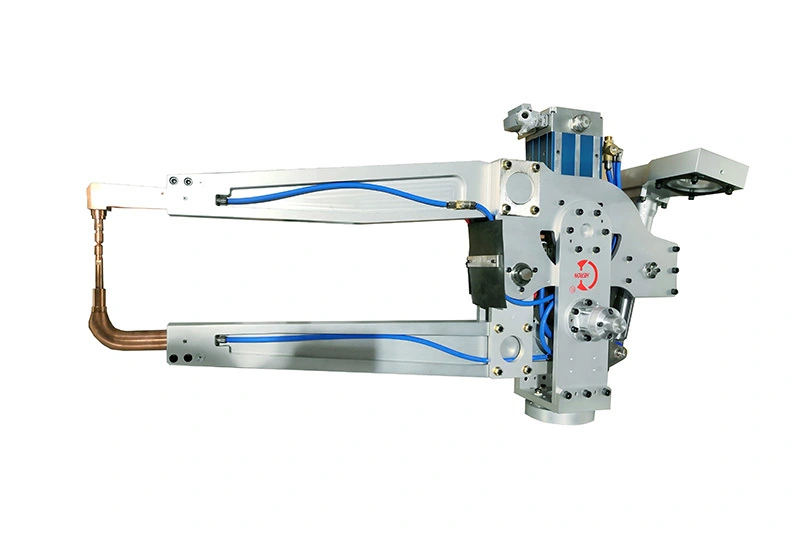
Aluminum has become a cornerstone material in modern manufacturing due to its lightweight structure, corrosion resistance, and high strength-to-weight ratio. However, joining aluminum efficiently and reliably remains one of the most technically demanding challenges in industrial production.
An aluminum spot welder is specifically engineered to overcome these challenges by delivering controlled high-current resistance welding optimized for aluminum alloys used in automotive, aerospace, electronics, and industrial fabrication.

As a global leader in resistance welding technology, Heron Welder provides advanced aluminum spot welding systems designed for high-speed automation, stable weld quality, and large-scale production environments.
Why Aluminum Is Difficult to Spot Weld
Aluminum behaves very differently from steel during resistance spot welding. Engineers and production teams often face process instability if equipment is not properly designed.
1. High Thermal and Electrical Conductivity
Aluminum rapidly conducts heat away from the weld zone, making it difficult to maintain sufficient temperature for nugget formation. It also has low electrical resistance, requiring significantly higher current input compared to steel welding.
2. Oxide Layer Formation
Aluminum naturally forms a tough oxide layer that has a much higher melting point than the base metal. This layer creates inconsistent contact resistance, which leads to unstable weld quality and defects if not properly managed.
3. Electrode Wear and Process Instability
Aluminum accelerates electrode degradation due to material transfer and alloy reactions at the electrode interface, reducing tool life and increasing maintenance cost.
These challenges make aluminum spot welding a highly controlled engineering process rather than a simple joining operation.
Working Principle of an Aluminum Spot Welder
An aluminum spot welder operates using the resistance heating principle, where electrical current is passed through clamped metal sheets to generate localized heat at the interface.
Step-by-Step Process
1. Clamping Phase
Electrodes apply high force to ensure stable contact between aluminum sheets, minimizing surface resistance variation.
2. Current Application
A high-amperage current (often several times higher than steel welding) is passed through the joint, generating heat due to electrical resistance.
3. Nugget Formation
The interface reaches melting temperature, forming a molten weld pool (nugget).
4. Solidification Under Pressure
Electrode force is maintained while the weld cools, producing a solid metallurgical bond.
Why MFDC Aluminum Spot Welders Are Industry Standard
Modern manufacturing has largely shifted toward MFDC (Medium Frequency Direct Current) aluminum spot welders for precision applications.
Key Advantages:
- Stable current output without zero-crossing
- Higher energy efficiency
- Improved weld consistency
- Reduced spatter and deformation
- Better control over thin aluminum sheets
Compared to traditional AC systems, MFDC technology provides significantly more stable heat input control, which is critical for aluminum applications in automotive and EV manufacturing.
Industrial Applications of Aluminum Spot Welding
Aluminum spot welding is widely used in industries where weight reduction and structural integrity are both critical.
1. Automotive & EV Manufacturing
Used in:
- Battery trays
- Body-in-white structures
- Lightweight chassis components
- EV enclosure systems
Electric vehicle platforms rely heavily on aluminum spot welders to maintain structural strength while reducing overall vehicle weight.
2. Aerospace Engineering
Aircraft manufacturers use aluminum spot welding for:
- Fuselage panels
- Internal structural frames
- Lightweight load-bearing components
Precision and repeatability are critical in these applications.
3. Electrical & Electronics Industry
Used for:

- Battery tabs
- Busbars
- Enclosures
- Heat-sensitive assemblies
4. Industrial Equipment Manufacturing
Applied in:
- HVAC systems
- Enclosures
- Machinery housings
Aluminum Spot Welder vs Steel Spot Welder
| Feature | Aluminum Spot Welder | Steel Spot Welder |
|---|---|---|
| Current requirement | Very high | Moderate |
| Heat control | Highly critical | More forgiving |
| Electrode wear | Fast | Slower |
| Oxide sensitivity | High | Low |
| Process stability | Requires advanced control | Easier |
Aluminum welding demands tighter process control and more advanced equipment calibration than steel.
Heron Welder’s Aluminum Spot Welding Solutions
Heron Welder designs industrial-grade aluminum spot welding systems optimized for high-volume manufacturing environments.
Key Engineering Strengths:
- MFDC inverter-based welding systems
- Intelligent welding controllers
- Automated production line integration
- High-duty cycle industrial electrodes
- Precision force and current control systems
These systems are engineered for:
- OEM production lines
- Automotive Tier 1 suppliers
- EV battery manufacturers
- Metal fabrication industries
With deep expertise in resistance welding, Heron delivers solutions that improve production efficiency, weld consistency, and long-term operational reliability.
Best Practices for Aluminum Spot Welding
To achieve consistent weld quality, manufacturers should follow these engineering practices:
1. Proper Surface Preparation
Removing oxide layers improves contact stability and reduces weld defects.
2. Optimized Welding Parameters
Key parameters include:
- High current input
- Short weld time
- Controlled electrode force
3. Electrode Maintenance
Regular dressing and monitoring extend electrode life and maintain weld consistency.
4. Process Monitoring Systems
Real-time monitoring ensures consistent weld quality across high-volume production.
Future of Aluminum Spot Welding in Industry 4.0
With the rise of electric vehicles and lightweight manufacturing, aluminum spot welding is becoming increasingly integrated with:
- AI-based quality inspection
- Digital welding controllers
- Smart factory automation
- Predictive maintenance systems
This shift is transforming welding from a manual parameter process into a fully data-driven manufacturing operation.
FAQs About Aluminum Spot Welder
1. Can aluminum be spot welded effectively?
Yes, but it requires specialized high-current MFDC spot welding systems due to aluminum’s conductivity and oxide layer challenges.
2. Why is aluminum harder to weld than steel?
Because it has higher thermal conductivity, lower electrical resistance, and forms a strong oxide layer that affects weld stability.
3. What type of aluminum spot welder is best?
MFDC (medium frequency DC) aluminum spot welders are the most effective for industrial applications.
4. Where is aluminum spot welding commonly used?
It is widely used in automotive manufacturing, EV battery production, aerospace, and industrial fabrication.
5. How does Heron Welder support aluminum welding applications?
Heron provides advanced resistance welding machines and automation systems optimized for high-quality aluminum spot welding in industrial environments.
Conclusion
An aluminum spot welder is not just a machine it is a precision engineering system designed to overcome the unique challenges of aluminum joining. From oxide management to high-current control, successful welding requires advanced technology and process stability.
For manufacturers seeking reliable, high-performance aluminum welding solutions, Heron Welder delivers industry-proven resistance welding systems built for modern production demands.
Request a Custom Welding Solution
Looking to improve aluminum joining efficiency in your production line?
Contact Heron Welder to discuss customized aluminum spot welding machines, automation integration, and complete resistance welding solutions designed for your manufacturing needs.