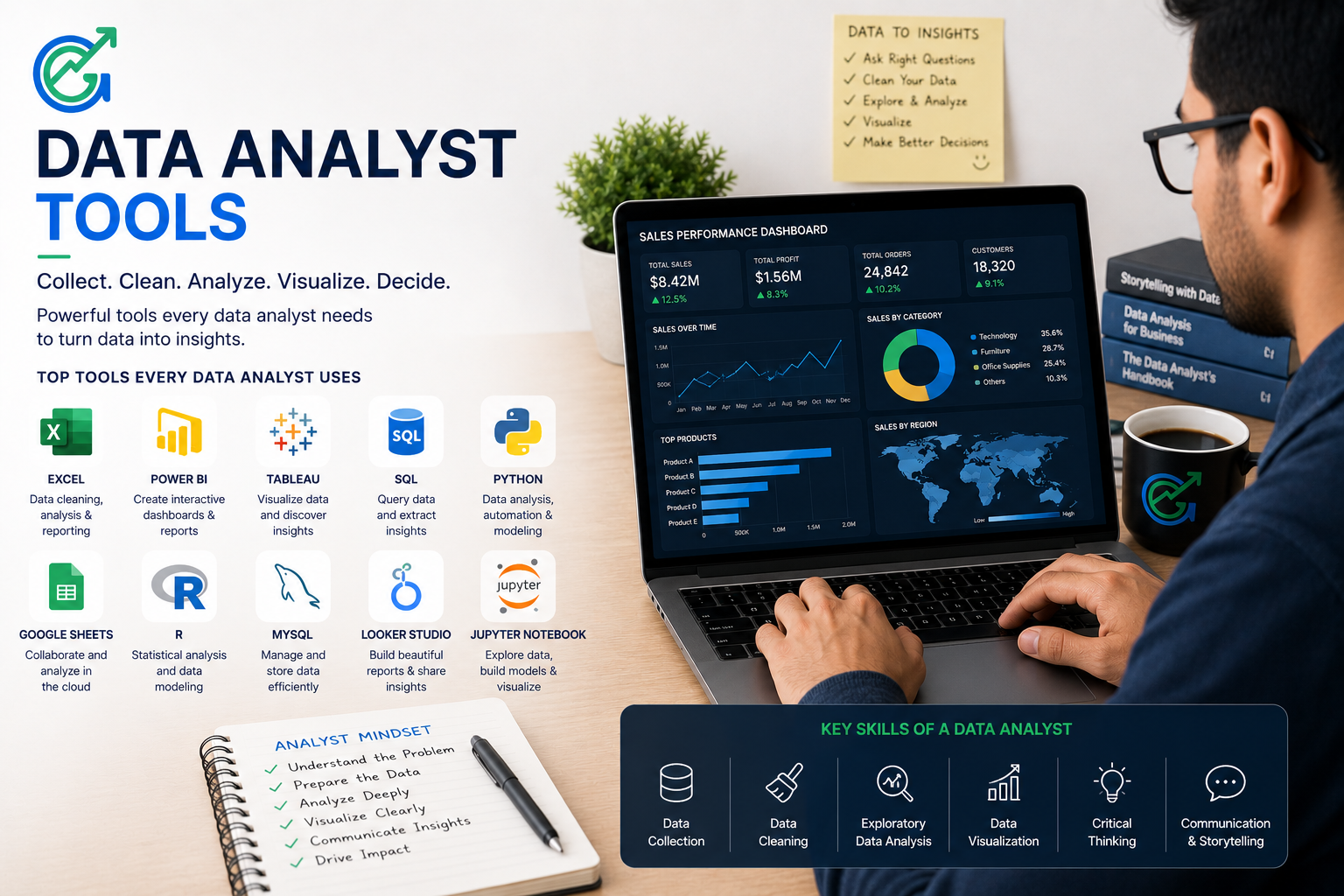
The digital landscape is shifting faster than ever, and for data professionals, staying relevant means more than just knowing how to “crunch numbers.” As we move into 2026, the demand for sophisticated data analytics tools has skyrocketed. Companies are no longer looking for basic reports; they want predictive insights, real-time automation, and AI-driven storytelling.
Whether you are a beginner looking to break into the field or a seasoned pro aiming to sharpen your edge, mastering the right data analytics tools is the ultimate career insurance. In this guide, we break down the top 10 essential tools you need to learn this year to stay ahead of the curve.
1. Microsoft Excel: The Timeless Foundation
Believe it or not, Excel isn’t going anywhere. Even in 2026, it remains one of the most accessible data analytics tools for quick calculations, data cleaning, and small-scale organization. For beginners, it provides a low-barrier entry point to understand logical functions, pivot tables, and basic data structuring.
In the modern workspace, Excel has evolved with AI integrations like Co-pilot, allowing analysts to generate complex formulas and charts using simple natural language. It’s the “Swiss Army Knife” that every analyst must keep in their pocket.
2. Python: The King of Automation and Scalability
If Excel is the foundation, Python is the powerhouse. When datasets become too large or complex for spreadsheets, Python steps in. As one of the most versatile data analytics tools, Python’s libraries—such as Pandas, NumPy, and Matplotlib—allow you to automate repetitive tasks and perform advanced statistical modeling with ease.
In 2026, Python is more than just a programming language; it is the glue that connects data engineering, machine learning, and business intelligence.
3. SQL (Structured Query Language)
You cannot be a data analyst without knowing how to talk to databases. SQL is the universal language used to communicate with relational databases. Whether you are working with PostgreSQL, MySQL, or SQL Server, this remains one of the non-negotiable data analytics tools in any tech stack.
Analysts use SQL to extract, filter, and join massive datasets, ensuring that only the most relevant information is pulled for further analysis.
4. Power BI: The Enterprise Leader
Microsoft Power BI has solidified its spot as a leader among data analytics tools for corporate environments. Its seamless integration with the Microsoft 365 ecosystem makes it the go-to choice for businesses that need interactive dashboards and real-time reporting.
With its advanced AI features, Power BI can now automatically spot trends and anomalies, saving analysts hours of manual searching.
5. Tableau: High-End Visual Storytelling
While Power BI is great for enterprise integration, Tableau is often preferred for its sheer creative flexibility and high-end visualization capabilities. It is widely regarded as one of the best data analytics tools for turning complex data into beautiful, interactive stories.
If your goal is to present data to C-suite executives in a way that is both engaging and easy to digest, Tableau is a skill you cannot afford to skip.
6. R: The Statistician’s Choice
For those leaning heavily into research, academia, or deep statistical analysis, R remains a top contender. Unlike Python, which is a general-purpose language, R was built by statisticians for statisticians.
It offers unparalleled packages for data modeling and graphical representation, making it one of the most specialized data analytics tools for high-level data science and financial forecasting.
7. Jupyter Notebook: The Analyst’s Playground
Collaboration is key in 2026, and Jupyter Notebook provides the perfect environment for it. It is an open-source web application that allows you to create and share documents containing live code, equations, and visualizations.
It supports multiple languages but is primarily used for Python and R, making it one of the most effective data analytics tools for documenting your thought process and sharing reproducible results with your team.
8. Apache Spark: Handling “Big Data”
As we move further into the decade, “Big Data” isn’t just a buzzword—it’s the reality. Traditional data analytics tools often struggle with petabytes of information. Apache Spark is an open-source processing engine built for speed and large-scale data processing.
Learning Spark is essential for analysts working in tech giants or data-heavy industries like e-commerce and telecommunications, where processing speed is a competitive advantage.
9. Looker Studio (formerly Google Data Studio)
For analysts working within the Google ecosystem (Google Analytics, BigQuery, Google Ads), Looker Studio is a lifesaver. It is a free, cloud-based tool that makes it incredibly easy to create real-time, shareable dashboards.
Its simplicity and cost-effectiveness make it one of the most popular data analytics tools for marketing analysts and small business owners who need quick, visual insights without a steep learning curve.
10. Google BigQuery: The Future of Cloud Data
Storing and querying massive amounts of data requires more than just a local server. BigQuery is Google’s fully managed, serverless data warehouse that enables super-fast SQL queries.
In 2026, more companies are migrating to the cloud, making BigQuery one of the most in-demand data analytics tools. It allows analysts to analyze billions of rows of data in seconds, providing the scalability needed for modern business demands.
Why Should You Master These Tools Now?
The job market is becoming increasingly competitive. Recruiters are no longer just looking for “an analyst”; they are looking for “a strategic partner” who can leverage these data analytics tools to drive revenue and efficiency.
Mastering a mix of these tools—such as a combination of SQL for retrieval, Python for processing, and Power BI for visualization—makes you a “full-stack” analyst. This versatility is what commands higher salaries and better job security in an AI-driven world.
How to Start Your Learning Journey?
If you’re feeling overwhelmed by the list, don’t worry. You don’t need to learn all ten at once. Start with the basics—Excel and SQL—and then move into a visualization tool like Power BI.
To accelerate your progress, consider a structured environment. For instance, Gradus offers specialized courses that bridge the gap between theoretical knowledge and industry-ready skills. Finding a program that focuses on hands-on projects will help you build a portfolio that proves your mastery of these data analytics tools to potential employers.
Final Thoughts: The Road Ahead in 2026
The world of data is evolving, and the data analytics tools we use are becoming smarter and more integrated. The “human” element of data analysis—asking the right questions, interpreting the “why” behind the “what,” and communicating insights effectively—is still irreplaceable.
However, your ability to perform these human tasks depends entirely on how well you can navigate the technical landscape. By mastering these ten data analytics tools, you aren’t just learning software; you are learning how to decode the future of business.
Data analytics is one of the fastest-growing fields in today’s digital world. It involves collecting, organizing, and analyzing data to help businesses make smarter decisions. From small startups to large companies, every organization uses data analytics to understand customer behavior, improve performance, and increase profits. In 2026, the demand for skilled data analysts is expected to grow even more because businesses rely heavily on data-driven strategies.
A data analyst works with tools like Excel, SQL, Power BI, Python, and Tableau to turn raw data into meaningful insights. These insights help companies identify trends, solve problems, and plan future strategies. Industries such as healthcare, finance, e-commerce, marketing, and technology all require data analytics professionals.
One of the biggest advantages of choosing a career in data analytics is the excellent salary opportunities and career growth. Beginners can start with entry-level positions and gradually move into advanced roles like business analyst, data scientist, or analytics manager. Additionally, data analytics is considered a beginner-friendly tech career because many online courses and training programs are available.
Learning data analytics not only improves technical skills but also enhances problem-solving and decision-making abilities. Making it a valuable career choice for the future.
Leave a Reply