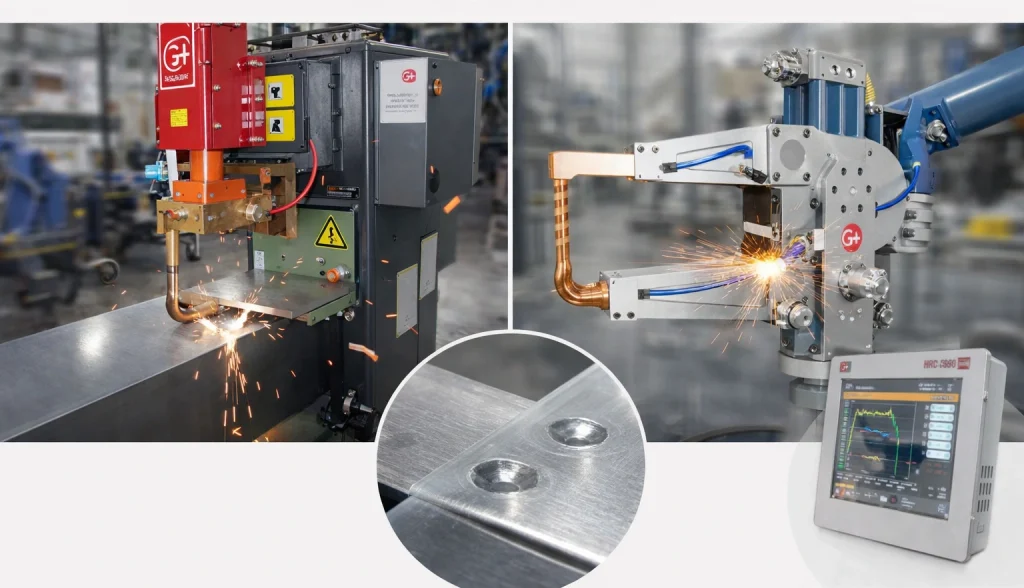
Aluminum has become one of the most critical materials in modern manufacturing due to its lightweight properties, corrosion resistance, and high strength-to-weight ratio. However, welding aluminum is significantly more challenging than welding steel because of its high thermal conductivity, oxide layer formation, and narrow process window.
This is where a spot welder for aluminum becomes essential. For OEMs, automotive suppliers, and industrial manufacturers, selecting the right resistance welding technology directly impacts production quality, cost efficiency, and structural reliability.

Heron Welder, a global manufacturer of advanced resistance welding and metal joining systems, delivers engineered solutions designed specifically to overcome the complexities of aluminum welding in high-volume production environments.
Understanding Spot Welding for Aluminum
Spot welding is a resistance welding process where two or more metal sheets are joined by applying pressure and electrical current through copper electrodes. The heat generated at the interface melts the material locally, forming a weld nugget that solidifies under pressure.
Why Aluminum is Difficult to Spot Weld
Aluminum presents unique challenges:
- High thermal conductivity: Heat dissipates quickly, requiring higher current input
- Oxide layer (Al₂O₃): Prevents proper electrical contact and fusion
- Low electrical resistance: Demands precise energy control
- Soft material behavior: Prone to electrode indentation and deformation
Because of these factors, a standard steel spot welding machine cannot deliver consistent results on aluminum. Specialized equipment and process control are required.
How a Spot Welder for Aluminum Works
A spot welder for aluminum is designed with enhanced power delivery, precise control systems, and optimized electrode design.
Key Process Steps
- Surface preparation and clamping
Electrodes apply controlled force to break through oxide layers. - Current application
High-density current flows through the aluminum sheets. - Heat generation at interface
Resistance heating melts the contact area rapidly. - Nugget formation under pressure
Molten metal solidifies into a strong weld joint. - Cooling phase
Pressure is maintained to ensure structural integrity.
Advanced Control Requirements
Modern aluminum spot welding systems require:
- High peak current output
- Precise pulse shaping (multi-pulse welding)
- Real-time feedback control
- Adaptive force control systems
- Water-cooled electrodes for thermal stability
Heron’s resistance welding systems integrate MFDC (Medium Frequency Direct Current) technology, which significantly improves energy efficiency and weld consistency for aluminum applications.
Types of Spot Welding Systems Suitable for Aluminum
Different production needs require different welding technologies.
1. MFDC Spot Welding Machines
Medium Frequency Direct Current systems are widely used for aluminum welding due to:
- Stable current output
- Reduced energy consumption
- Better control of heat input
- High repeatability in automated production lines
These systems are ideal for automotive body panels and battery housings.
2. Capacitor Discharge (CD) Spot Welders
Capacitor discharge welding delivers a very fast, high-energy pulse.
Advantages include:
- Extremely short weld time
- Minimal heat affected zone
- Reduced distortion
- Ideal for thin aluminum sheets
Commonly used in electronics and precision assemblies.
3. Robotic Spot Welding Systems
For high-volume manufacturing, robotic integration is essential.
Benefits include:
- Consistent weld quality
- Reduced human error
- High-speed cycle times
- Seamless integration with production lines
Heron Welder designs automated welding cells that combine robotics, power control units, and fixture systems for scalable production.
Applications of Aluminum Spot Welding
A reliable spot welder for aluminum is used across multiple industries:
Automotive Manufacturing
- Body-in-white structures
- EV battery trays and enclosures
- Lightweight chassis components
Aerospace Industry
- Aircraft interior panels
- Structural lightweight assemblies
- Fuel system components
Electronics Industry
- Heat sinks
- Aluminum enclosures
- Battery terminals
HVAC and Industrial Equipment
- Compressor housings
- Aluminum ducting systems
- Cooling system assemblies
Renewable Energy Sector
- Solar panel frames
- Energy storage systems
- Battery module manufacturing
Key Challenges in Aluminum Spot Welding
Even with advanced equipment, manufacturers must manage several process challenges:
1. Electrode Wear
Aluminum tends to stick to electrodes, leading to:
- Reduced electrode life
- Inconsistent weld quality
- Increased maintenance costs
Solution: Use specialized electrode materials and automated dressing systems.

2. Process Sensitivity
Small variations in:
- Pressure
- Current
- Surface condition
can significantly affect weld quality.
Solution: Closed-loop control systems with real-time monitoring.
3. Surface Contamination
Oxide layers and oil residues reduce weld strength.
Solution: Proper cleaning systems or integrated surface preparation techniques.
Best Practices for Spot Welding Aluminum
To achieve high-quality welds, manufacturers should follow these best practices:
Optimize Weld Parameters
- Increase current levels compared to steel welding
- Use shorter weld times to prevent overheating
- Apply controlled electrode force
Use Advanced Electrode Designs
- Dome-shaped electrodes for better current concentration
- Water-cooled tips for heat dissipation
- High-conductivity copper alloys
Implement Automation
- Robotic arms for consistency
- Sensor-based feedback systems
- Real-time process monitoring
Maintain Surface Quality
- Clean aluminum sheets before welding
- Minimize oxide buildup
- Store materials in controlled environments
Why MFDC Technology is Ideal for Aluminum Spot Welding
Medium Frequency Direct Current technology is widely recognized as the most efficient solution for aluminum welding in industrial environments.
Advantages:
- Higher energy efficiency compared to AC systems
- Improved weld consistency
- Better control of heat input
- Reduced transformer size and energy losses
- Stable performance in automated production lines
Heron Welder integrates MFDC systems with intelligent controllers, ensuring precise control over every weld cycle, which is critical for aluminum applications.
Heron Welder: Engineering Excellence in Resistance Welding
Heron Welder specializes in advanced resistance welding technologies designed for demanding industrial applications. With a strong focus on automation, precision, and durability, Heron systems are widely used in automotive, energy storage, and heavy manufacturing sectors.
Our aluminum welding solutions include:
- MFDC spot welding machines
- Capacitor discharge welding systems
- Robotic welding cells
- Custom automation integration
- High-performance welding guns and controllers
Each system is engineered to deliver stable performance in high-speed production environments while maintaining strict quality standards.
Future of Aluminum Spot Welding
As industries move toward lightweight materials and electric mobility, aluminum welding demand is increasing rapidly.
Future trends include:
- AI-driven weld monitoring systems
- Fully autonomous welding lines
- Adaptive welding parameters using machine learning
- Increased use of multi-material joining systems
- Greater energy efficiency requirements
Manufacturers investing in advanced spot welding technology today will gain a significant competitive advantage in tomorrow’s market.
FAQs: Spot Welder for Aluminum
1. Can aluminum be spot welded easily?
Aluminum can be spot welded, but it requires specialized equipment due to its high conductivity and oxide layer. Standard steel welders are not suitable.
2. What type of spot welder is best for aluminum?
MFDC spot welding machines and capacitor discharge welders are most effective for aluminum due to precise energy control and fast welding cycles.
3. Why does aluminum require higher welding current?
Because aluminum has low electrical resistance and high thermal conductivity, more current is needed to generate sufficient heat at the weld interface.
4. How can weld quality be improved in aluminum spot welding?
Improving surface preparation, using advanced electrode designs, and implementing automated control systems significantly enhances weld quality.
5. Is robotic spot welding necessary for aluminum applications?
For high-volume manufacturing, robotic welding ensures consistency, reduces defects, and increases production efficiency, making it highly recommended.
Conclusion
A spot welder for aluminum is a critical investment for manufacturers working with lightweight, high-performance materials. Due to aluminum’s unique physical properties, successful welding requires advanced control systems, precise energy delivery, and optimized electrode technology.
Heron Welder provides industry-grade solutions designed to meet these challenges with reliability and precision, supporting OEMs and manufacturers in achieving superior weld quality and production efficiency.
For customized aluminum welding solutions, automation integration, or project consultation, contact Heron Welder to explore how advanced resistance welding technology can transform your manufacturing process.