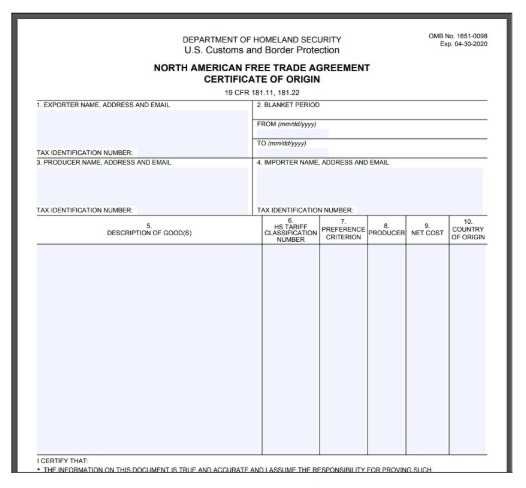
A NAFTA Cert plays an important role in trade between the United States, Canada, and Mexico because it helps determine whether imported goods qualify for reduced or eliminated duty under NAFTA rules of origin. It is not just a routine form. It can directly affect customs treatment, total landed cost, and the speed at which shipments move across borders.
For companies that regularly buy, sell, or distribute goods internationally, understanding the purpose of a NAFTA Cert can help reduce unnecessary complications. When trade documentation is handled correctly, businesses are better positioned to avoid delays, support compliance, and protect the financial benefits available through qualifying trade agreements.
Why the Certificate Is Important
The main purpose of a NAFTA Cert is to confirm that a product qualifies as originating under the agreement. Customs authorities do not rely only on where a shipment was sent from. They look for documentation that shows the goods meet the required origin rules before granting preferential tariff treatment.
This matters because a shipment may move between North American countries without automatically qualifying for lower duties. A business that assumes eligibility without proper documentation may face added costs or customs issues. That is why the certificate becomes a practical part of trade planning rather than just an administrative extra.
Responsibility for Completion
In most cases, the exporter is responsible for preparing the NAFTA Cert. That makes accuracy especially important, because the importer often depends on the exporter’s documentation to support a claim for preferential tariff treatment at the time of entry.
If the form is incomplete, inconsistent, or unsupported by records, the importer may lose access to the expected duty benefit. Even when goods would otherwise qualify, mistakes in paperwork can create problems that affect both shipment timing and total transaction cost. For that reason, businesses should treat the certificate as a core part of export compliance.
Details Matter in Trade Documents
A NAFTA Cert typically includes information such as the exporter’s details, importer details, producer information, a description of the goods, tariff classification, preference criterion, and country of origin. Each part of the document contributes to the customs authority’s ability to evaluate whether the product qualifies under the agreement.
This level of detail shows why precision matters. A vague description, incorrect classification, or unsupported origin claim can weaken the document and lead to questions during customs review. Companies that handle cross-border shipments should make sure their documentation is specific, consistent, and aligned with the rest of the shipping paperwork.
Value for Importers and Exporters
The practical value of a NAFTA Cert comes down to cost and predictability. When a qualifying shipment is supported by correct documentation, the importer may be able to receive reduced or eliminated duty. Over time, that can create meaningful savings across multiple transactions.
This is especially important for businesses with regular cross-border activity. A reliable documentation process can improve planning, support pricing decisions, and make it easier to estimate the full cost of moving goods between markets. In that sense, the certificate is tied not only to compliance, but also to operational efficiency.
Recordkeeping Supports Compliance
A NAFTA Cert should not be viewed as a one-time document that disappears after customs clearance. Trade-related certificates are typically part of a larger compliance trail that may need to be reviewed later, especially if a customs authority questions the basis of the claim.
Good recordkeeping supports the credibility of the certificate and helps businesses respond more effectively if additional information is requested. Keeping origin records, product details, and related shipping documentation organized can make a major difference in protecting the company’s position during audits or follow-up reviews.
Relevance for Industrial Trade
The need for a NAFTA Cert can be especially relevant in industrial supply chains. Orders involving replacement components, technical equipment, and repeat shipments often carry enough value and complexity that proper origin documentation becomes an important part of the transaction.
Conclusion
A NAFTA Cert remains an important document for businesses involved in cross-border trade because it helps support tariff preference claims, confirm origin, and improve documentation accuracy. For industrial suppliers, distributors, and buyers shipping machine and parts, giving proper attention to origin documentation can make international transactions more efficient, more predictable, and easier to manage over time. Companies that understand their purpose are better prepared to avoid delays, control costs, and maintain a smoother customs process.