Every seasoned business leader, IT director, or operations manager has at least one horror story about a custom software project. The narrative is almost always the same: a brilliant idea is conceptualized, massive budgets are approved, and a detailed requirements document is handed over to a development team. Then, the business waits. Six, eight, or sometimes twelve months later, the application is finally unveiled.
The code might be flawless, but the project is a failure. Why? Because the software was built for the business as it existed a year ago, or worse, it was built based on assumptions about how end-users should work, rather than how they actually work.
In today’s hyper-competitive landscape, relying on this outdated, slow-moving development cycle is a liability. The modern enterprise requires agility, rapid validation, and financial risk mitigation. This is where the concept of the Minimum Viable Product (MVP) intersects with low-code technology. By leveraging Microsoft Power Apps, strategic consultants are revolutionizing how businesses prototype, test, and deploy custom software. Instead of waiting months to see a return on investment, stakeholders are interacting with working, functional prototypes in a matter of weeks.
Here is a deep dive into how agile methodology, combined with strategic Power Platform development, is changing the way we build enterprise software.
The High-Stakes Gamble of Traditional Software Development
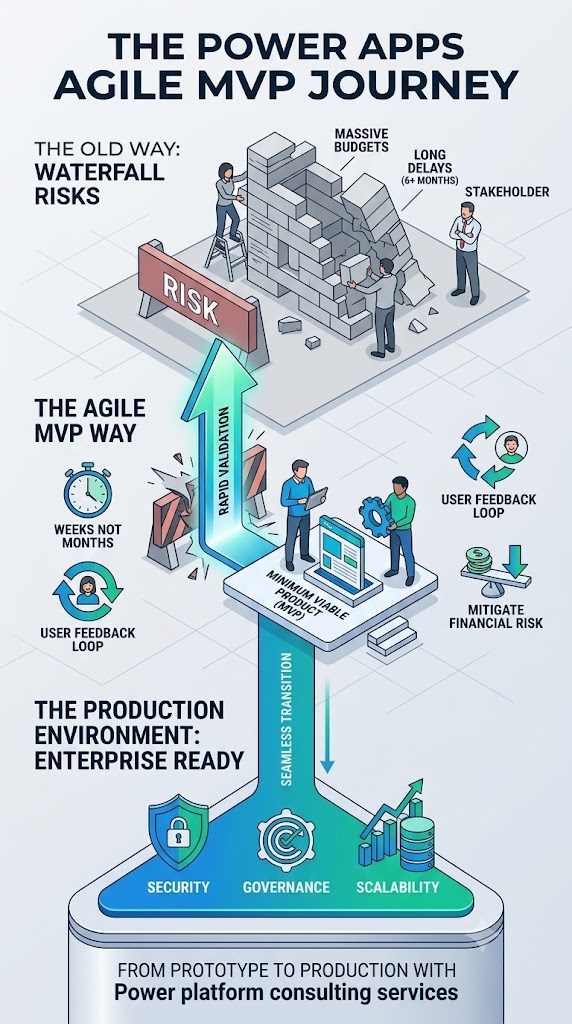
To understand the value of an Agile MVP, we must first look at the inherent flaws of the traditional “waterfall” software development lifecycle. In the conventional model, the process is linear and rigid: define, design, build, test, and deploy.
The biggest risk in this model is the assumption that stakeholders know exactly what they need before a single line of code is written. In reality, users rarely know what they truly need until they have a system in front of them to interact with. When a business commits to a traditional ground-up build, they are placing a massive financial bet on unproven assumptions.
Consider the financial and operational implications:
-
Massive Upfront CapEx: Ground-up development requires funding a full stack of developers, UI/UX designers, database architects, and project managers for months before seeing a tangible product.
-
The “Feature Creep” Trap: Because stakeholders know they only have one shot to get the software built, they try to cram every conceivable feature into the initial release. This bloats the budget, extends the timeline, and complicates the user experience.
-
The Feedback Void: For months during the build phase, end-users are completely detached from the project. By the time they finally test the software, it is too late (and too expensive) to pivot if the core logic is flawed.
Building enterprise software shouldn’t feel like a trip to the casino. The solution is to change the development paradigm from “build it perfectly the first time” to “build it fast, test it early, and iterate constantly.”
Redefining the MVP: Why Power Apps Changes the Game
The Minimum Viable Product (MVP) is a core tenant of Agile methodology. An MVP is not a half-baked or broken application; rather, it is the most streamlined version of your software that still delivers core business value. It includes only the essential features needed to solve the primary problem and gather real-world user feedback.
Historically, building an MVP still required significant coding time. But Microsoft Power Apps has fundamentally altered this timeline.
Power Apps is a high-productivity, low-code development platform that allows consultants to assemble applications using pre-built UI components, drag-and-drop interfaces, and standardized data connectors.
This speed is the ultimate catalyst for the Agile MVP. A consultant can sit in a discovery meeting on a Monday, map out the business logic on Tuesday, and have a clickable, functional prototype ready for stakeholders to review by the following week.
However, speed without structure is just chaos. When rapidly prototyping, it is critical to ensure that the foundation is secure and compliant. This is why many organizations choose to collaborate with a certified Microsoft partner in USA; doing so ensures that even the earliest iterations of the MVP are built on a compliant architecture that aligns with strict domestic data residency regulations, industry standards, and enterprise security frameworks. The goal is to move fast, but never at the expense of data integrity.
The Engine of Agile: Rapid Iteration and Real-Time Feedback Loops
The true power of the Power Apps MVP isn’t just how quickly it can be built, but what happens after it is built. Agile methodology thrives on the user feedback loop, and Power Apps is the perfect vehicle for this process.
The Wireframe Fallacy
In traditional design, developers present users with static wireframes or mockups. The problem is that humans are terrible at visualizing dynamic workflows from static images. A user might look at a wireframe and say, “Yes, that looks fine.” But when you give them a working application on their tablet, they immediately realize, “Wait, I need to see the customer’s purchase history before I can approve this discount.”
Real-Time Adjustments
Because a Power Apps MVP is functional, stakeholders can click the buttons, input data, and trigger actual workflows. This creates immediate, high-quality feedback.
When a consultant runs an Agile sprint using Power Apps, the iteration process becomes highly collaborative.
-
Week 1: The consultant deploys the MVP. It focuses purely on data capture—for example, a field service technician logging an equipment inspection.
-
Week 2: The technicians test the app in the field. They report that the dropdown menu for “Equipment Type” is too long and slows them down.
-
Week 3: Because it is low-code, the consultant instantly modifies the app to use a dynamic search bar instead of a dropdown, and pushes the update live.
| Development Metric | Traditional Waterfall Development | Agile MVP via Power Apps |
| Time to First Prototype | 3 to 6 Months | 1 to 3 Weeks |
| User Feedback Integration | Post-launch (High cost to change) | Continuous (Low cost to change) |
| Initial Feature Scope | Bloated (Trying to predict all needs) | Lean (Focused strictly on core value) |
| Stakeholder Visibility | Low (Reading status reports) | High (Interacting with working software) |
Mitigating Financial Risk: The “Fail Fast, Succeed Cheaper” Philosophy
At the executive level, the most compelling argument for the Agile MVP approach is risk mitigation. Capital is finite, and investing heavily in unproven digital transformation initiatives is a fast way to drain a corporate budget.
The Agile MVP introduces the philosophy of “Failing Fast.” In the innovation space, failure is not a bad word; it is simply the discovery that a specific hypothesis was incorrect. The problem arises when a company spends $150,000 to discover their hypothesis was wrong.
Using Power Apps to build an MVP drastically lowers the cost of experimentation. If a business unit believes that a new custom CRM interface will increase sales team productivity, they don’t need to commit to a massive six-figure development contract. A consultant can build a highly targeted MVP in Power Apps for a fraction of that cost.
This approach transforms software development from a blind gamble into a measured, data-driven investment strategy.
From Prototype to Production: The Seamless Enterprise Transition
One of the historical criticisms of rapid prototyping is that MVPs were often built using “throwaway code.” In the past, a team might build a quick prototype in a cheap, consumer-grade tool just to prove a concept, but when it came time to deploy the app to 5,000 employees, the prototype had to be discarded, and the real application had to be coded from scratch.
Prototype
This is where the Microsoft ecosystem provides a distinct architectural advantage. A prototype built in Power Apps is not throwaway code.
When the business logic is validated and the company is ready to scale, the transition is seamless, provided it is managed correctly. This scaling phase is typically where organizations bring in specialized powerapps consulting services. Expert consultants take the validated MVP and “harden” it for the enterprise.
This process involves:
-
Database Migration: Upgrading the backend data source from a simple SharePoint list (used for quick prototyping) to a robust, scalable Microsoft Dataverse or Azure SQL environment.
-
Security and Governance: Implementing strict Role-Based Access Control (RBAC) so that frontline workers, managers, and executives only see the data they are legally authorized to view.
-
Application Lifecycle Management (ALM): Setting up secure deployment pipelines (Dev, Test, Prod environments) so that future updates can be rolled out safely without disrupting live business operations.
-
Complex Integrations: Connecting the validated Power App to legacy ERP systems, third-party APIs, or sophisticated Power Automate workflows to eliminate manual data entry entirely.
The beauty of this process is that the core user interface—the screens and logic that the stakeholders have spent weeks perfecting—remains intact. The business doesn’t lose a step.
Conclusion
The era of writing blank checks for theoretical software is over. Today’s business environment demands tangible results, measurable ROI, and the flexibility to pivot at a moment’s notice.
By adopting an Agile methodology and leveraging the rapid prototyping capabilities of Microsoft Power Apps, organizations can fundamentally change how they approach digital transformation.
Through rapid iteration, continuous user feedback loops, and strict financial risk mitigation, businesses can finally build custom software that actually works the way their people work.