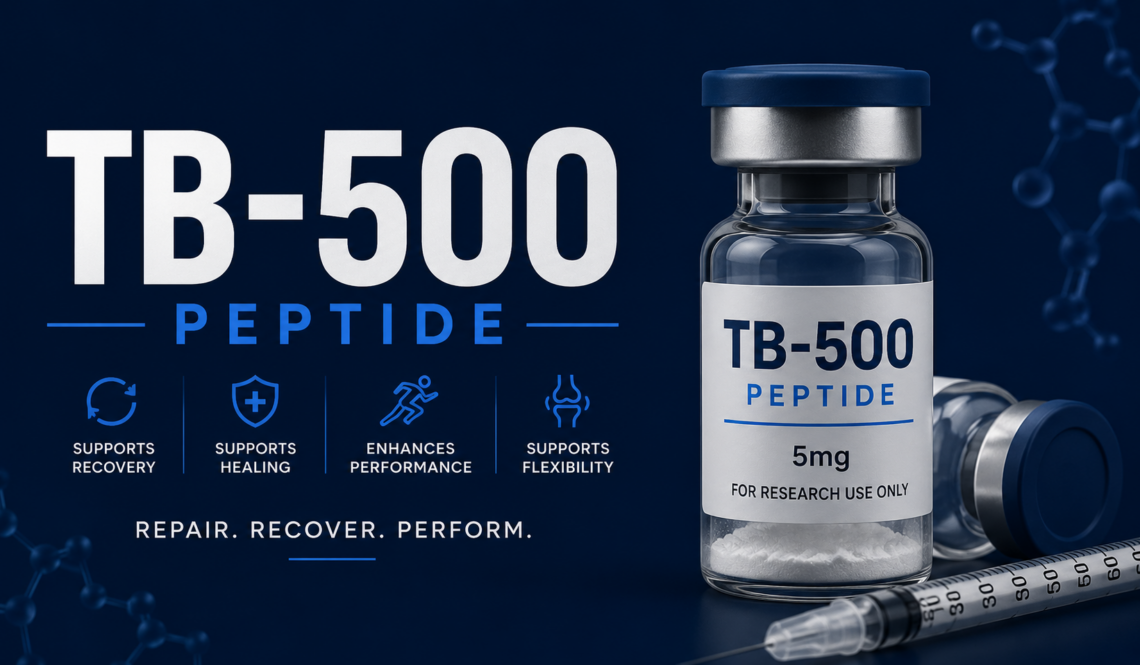
In recent years, research peptides have sparked increasing interest among researchers, sports professionals, and individuals seeking information on cell repair and regeneration processes. Among the frequently mentioned peptides is TB-500, a beta-4 thymosin-related peptide primarily studied in preclinical settings.
However, commercial interest should not be confused with clinical evidence. Before considering any such product, it is essential to understand what it is, what has actually been researched, what its limitations are, and what safety and regulatory issues remain open.
This article from Pepta Supply offers an informative and prudent overview for readers in Spain who wish to learn more about the topic, without presenting the product as a medicine or providing instructions for its use in humans.
What is TB 500 peptide?
The TB500 peptide is commonly described as a synthetic fragment related to thymosin beta-4 (Tβ4), a naturally occurring protein composed of 43 amino acids. The fragment marketed as TB500 should not be automatically considered identical to the full protein.
This distinction is important because some of the available scientific literature on full beta-4 thymosin does not necessarily demonstrate that a commercial fragment has exactly the same effects, biological behavior, or safety profile.
The FDA itself has pointed out that the name TB-500 has been used commercially for different forms, salts, and derivatives, which can create problems of chemical identification and make it difficult to compare products.
Therefore, when evaluating any material intended for research, attention should be paid to its chemical identity, analytical documentation, declared purity, and traceability, rather than relying solely on the name used on a commercial website.
What do researchers study?
Thymosin beta-4 has been the subject of research related to cellular processes such as cell migration, cytoskeleton organization, angiogenesis and certain responses associated with tissue repair.
These mechanisms have generated scientific interest in areas such as wound research, connective tissue, and cell regeneration. However, many of the results come from cell or animal studies and do not constitute proof of therapeutic efficacy in humans.
This difference is especially relevant in the case of TB-500. The results obtained with full beta-4 thymosin cannot be automatically transferred to a synthetic fragment marketed as TB-500.
In other words, the existence of an interesting biological hypothesis does not mean that a clinically proven treatment exists.
TB-500 and scientific evidence: separating marketing research
One of the biggest problems when searching for information on research peptides is the mix of scientific evidence, personal experiences, and advertising claims.
Online, you can find references to muscle recovery, tendons, ligaments, sports injuries, wound healing, or regeneration. However, the available evidence does not support all of these claims as proven benefits in humans.
The FDA has indicated that there are significant gaps in information regarding human exposure to products containing the beta-4 thymosin fragment, in addition to concerns related to potential impurities and immunogenicity of peptide products.
For this reason, any responsible content should use expressions such as “researched”, “studied in preclinical models” or “subject of research”, rather than claiming that the peptide cures injuries or accelerates human recovery.
Is there an established human dosage?
There is no approved human dose that can be recommended for TB-500 as a medical treatment.
This is crucial. Protocols published on forums, social media, or commercial websites are not equivalent to validated clinical guidelines. The absence of an approved dosage also means that it is inappropriate to convert anecdotal protocols into administration instructions.
Furthermore, different products may vary in formulation, concentration, purity, or chemical identity. Therefore, copying a protocol found online can introduce additional risks.
Safety: What should be taken into account?
The main safety consideration is the lack of sufficient clinical data on the specific fragment.
When a compound lacks adequate clinical studies, it is not possible to confidently establish its short- or long-term safety profile, interactions, effects on different population groups, or consequences of repeated exposure.
There are also risks associated with the research product itself. A label, photograph, or commercial description is no substitute for independent laboratory analysis.
Among the aspects that researchers may consider when evaluating peptide materials are:
- Identity of the compound.
- Analytical purity.
- Presence of impurities.
- Product integrity.
- Batch traceability.
- Certificate of Analysis (COA).
- Storage conditions.
- Consistency between batches.
Pepta Supply states that its materials are supplied exclusively for scientific and laboratory research, and that it has analytical documentation for its products. It also states that they are not intended for human, veterinary, therapeutic, or diagnostic use.
Is it approved for medical use?
One of the most important questions before acquiring any peptide is to know its regulatory status.
TB-500 should not be presented as an approved drug for treating injuries, pain, illnesses, or recovery problems. Available regulatory sources show significant limitations regarding its authorization and the safety data necessary to support its therapeutic use.
Recent information from the FDA also highlights problems related to the characterization of the material and the lack of information on human exposure.
For consumers in Spain, this means that a sales page for a material labeled for research should not be interpreted as an authorization to use it as a medicine.
Situation in sports
Athletes should pay special attention.
Thymosin beta-4 and its derivatives, including TB-500, are listed among the substances prohibited by anti-doping regulations. Information from Sport Integrity Australia confirms that thymosin beta-4, also known as TB-500, is banned in sport and is included on the 2026 Prohibited List.
Therefore, an athlete subject to anti-doping controls should always check the current regulations of their federation and consult a qualified professional before using any experimental substance.
What does “tb 500 vendita” mean?
The phrase “tb 500 vendita” appears primarily in commercial searches related to buying or selling the product. For users in Spain, it’s important to understand that finding a product available in an online store doesn’t necessarily mean it’s authorized as a medicine for human consumption.
When looking for a supplier of research materials, the focus should be on transparency and documentation, not just on price or claims about purported results.
Features worth checking include product information, batch data, certificates of analysis, and the conditions under which it is marketed.
Where can I find information about the product?
Pepta Supply offers peptide materials intended for research and clearly specifies its Research Use Only (RUO) policy. The company states that its products are not drugs and that the buyer is responsible for ensuring compliance with applicable laws and regulations in their country.
To view available commercial information about the specific product:
It is important to always read the information provided by the supplier and verify that the intended use complies with applicable regulations. A purchase intended for laboratory research is conceptually different from acquiring a product for self-medication.
What should an investigator check?
Before incorporating a peptide into a project, a researcher should evaluate the material from a scientific and documentary perspective.
1. Identity
The trade name alone is not sufficient. The chemical identity must be clearly specified in order to correctly interpret the results.
2. Pureza
The declared purity can be relevant for replicating experiments and reducing uncontrolled variables. Ideally, it should be supported by appropriate analytical methods.
3. Certificate of analysis
A Certificate of Analysis (COA) can provide information about a specific batch. It is preferable to review batch-specific documentation rather than relying solely on general marketing claims.
4. Traceability
Traceability allows a sample to be linked to its batch, documentation, and corresponding quality controls.
5. Storage conditions
Peptides can be sensitive to factors such as temperature, humidity, and light. Researchers must follow the conditions specified by the supplier to preserve the integrity of the material.
Common mistakes when researching TB-500
One of the most frequent mistakes is treating personal testimonies as if they were clinical trials.
Another mistake is assuming that a substance related to a naturally occurring human protein is automatically safe. The presence of a molecule or molecular family in the body does not guarantee that a particular synthetic formulation, concentration, or route of exposure is safe.
It is also problematic to confuse research on full beta-4 thymosin with research specifically on the commercial fragment TB-500.
Finally, buying a product labeled as “research use only” and subsequently using it on humans does not transform the material into an approved drug.
A responsible perspective for Spain
For Spanish readers, the best approach is to combine three elements: scientific evidence, regulatory information, and supplier documentation.
If the goal is to conduct laboratory research, it is advisable to work with controlled procedures and proper documentation. If the goal is to treat an injury, illness, or medical problem, the appropriate option is to consult a healthcare professional and use only treatments authorized for the corresponding indication.
It should not be assumed that a product available online has been evaluated by health authorities for the use that some users may attribute to it.
Conclusion
Interest in TB500 reflects the growing attention given to peptides related to cell repair and regeneration processes. However, the popularity of a compound does not replace clinical evidence.
The tb 500 peptide must be understood within its context: a research material related to thymosin beta-4, with scientific results that arouse interest but with significant limitations when trying to translate those findings into human treatments.
For researchers and buyers in Spain, the priority should be the correct identification of the compound, analytical documentation, traceability, and regulatory compliance. Pepta Supply markets its products under a model for exclusive use in research and not as medicines for human consumption.
The available information also advises caution regarding claims about recovery, regeneration, or treatment of injuries. Until adequate clinical data are available, such claims should not be presented as proven medical benefits.
Frequently Asked Questions
1. Is TB-500 an approved drug?
It should not be considered an approved drug for treating human diseases or injuries. The available evidence and regulatory framework have significant limitations.
2. Is TB 500 peptide the same as thymosin beta-4?
Not necessarily. TB-500 is marketed as a fragment related to thymosin beta-4, whereas full-length thymosin beta-4 is a 43-amino-acid protein.
3. Is there an official human dosage?
There is no approved human dose that can be recommended as a treatment. Protocols published online are not a substitute for clinical evidence.
4. Is it allowed in sports?
No. Thymosin beta-4 and its derivatives, including TB-500, are among the substances prohibited by anti-doping rules.
5. What does Pepta Supply sell these materials for?
Pepta Supply states that its products are supplied exclusively for scientific and laboratory research, not for human, veterinary, therapeutic or diagnostic use .