Search has changed a lot in the last few years.
People still type questions into Google, but they are also asking longer questions, comparing options, looking for quick answers, and using AI tools before visiting a website.

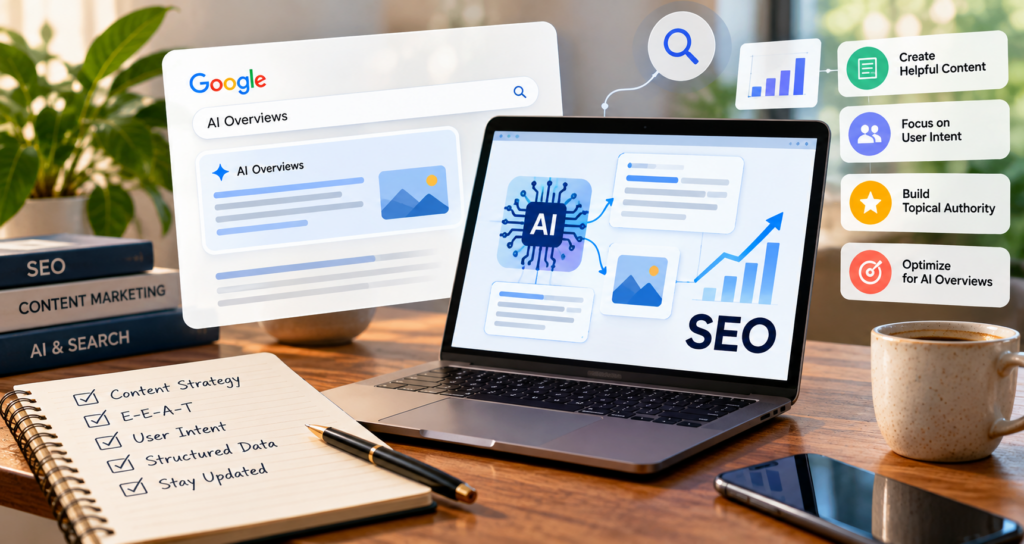
Google has responded to this shift with AI Overviews.
For SEO professionals, this creates a big question.
If Google can answer a search directly on the results page, why would someone click a website?
The answer is not as simple as “SEO is dead.”
Websites can still attract valuable traffic. But the way you think about visibility needs to change.
In 2026, SEO is less about trying to rank one page for one keyword and more about making your website useful, trustworthy, easy to understand, and strong enough to be referenced in search experiences.
So, how should marketers adapt to AI Overviews in 2026?
Let’s break it down.
What Are Google AI Overviews?
Google AI Overviews are AI-generated summaries that can appear at the top of some search results.
Instead of showing only traditional blue links, Google may provide a summary that brings together information from multiple sources.
For example, imagine someone searches:
“What are the best ways to improve local SEO for a small business?”
Instead of seeing only a list of websites, the searcher may see an AI-generated response containing:
- Key recommendations
- Supporting information
- Links to relevant sources
- Follow-up questions
- Traditional search results
The exact appearance and availability of AI Overviews can vary by search and location.
This changes the search journey.
The user may get part of the answer before clicking anything.
That is where marketers need to rethink their SEO strategy.
Are AI Overviews Replacing Traditional SEO?
Not exactly.
Traditional search results still matter.
People continue to visit websites for:
- Detailed explanations
- Product comparisons
- Original research
- Reviews
- Services
- Local businesses
- Expert opinions
- First-hand experiences
- Complex topics
Think about the last time you searched for a product or service.
A short AI answer may help you understand the basics. But when you are about to spend money, you may still want to visit a real website, read reviews, compare options, and check who is providing the service.
That creates an important distinction.
SEO is not only about getting the click anymore.
It is also about becoming a source that search systems can understand, trust, and reference.
What Does AI Overviews Mean for SEO in 2026?
AI Overviews can change how users interact with search results.
A traditional SEO funnel often looked like this:
Search query → Google results → Website click → Conversion
The journey can now look more like:
Search query → AI-generated answer → Source links → Website research → Conversion
Or:
Search query → AI answer → Follow-up search → Website visit → Conversion
This means marketers need to think beyond rankings.
A page ranking in position one is useful.
But what happens if the searcher sees enough information in an AI Overview and never clicks?
You need to ask a different question.
Is your brand still visible and useful during the search journey?
Focus on Search Intent Instead of Just Keywords
Keyword research still matters.
But copying a keyword into a heading 15 times will not help you build a useful page.
Start by understanding why someone is searching.
Search intent usually falls into categories such as:
- Informational
- Commercial
- Transactional
- Navigational
- Local
Consider the keyword:
“best digital marketing course in Nagpur”
Someone searching this may want to compare courses, check fees, look at course modules, read reviews, and understand whether the course is suitable for beginners.
A page that only says “We offer the best Digital Marketing course in Nagpur” does not answer those questions.
A useful page could explain:
- Course duration
- Modules
- Practical projects
- Trainer experience
- Learning format
- Certification
- Placement support
- Fees
- Who the course is suitable for
- Frequently asked questions
That is much closer to the actual search intent.
Create Content That Answers Real Questions
AI Overviews are designed to answer questions.
That makes question-based content more useful than ever.
Look at the questions your audience actually asks.
For a digital marketing institute, these might include:
- Is digital marketing difficult for beginners?
- How long does it take to learn SEO?
- What does a digital marketing course include?
- Is a digital marketing certificate useful?
- What is the average salary after learning digital marketing?
- Which SEO tools should beginners learn?
- Can I learn digital marketing without coding?
Instead of creating one short article for every question, build useful pages that cover related questions naturally.
This can also help you build topical depth.
Build Topic Clusters
One article is rarely enough to demonstrate strong coverage of a broad subject.
Suppose your main topic is SEO.
You could create a main SEO guide supported by pages covering:
- Keyword research
- On-page SEO
- Technical SEO
- Link building
- Local SEO
- Google Search Console
- GA4
- SEO audits
- Internal linking
- Structured data
- SEO reporting
- AI and SEO
These pages can link to each other where relevant.
This gives users a clearer path through your website.
It also helps search engines understand the relationship between your content.
First-Hand Experience Matters More
AI can generate generic information quickly.
That makes first-hand experience more valuable.
Imagine two articles about Google Search Console.
Article one explains what Search Console is using information that could appear on hundreds of websites.
Article two explains:
- How an SEO professional uses Search Console
- Common indexing problems they have seen
- Examples of search queries from real projects
- How they interpret impressions and clicks
- Common reporting mistakes
- What they check after a website migration
Which one feels more useful?
The second article has something difficult to copy.
Experience.
When appropriate, include real examples, screenshots, original observations, case studies, processes, and lessons from actual work.
Strengthen E-E-A-T
Google’s E-E-A-T framework stands for:
- Experience
- Expertise
- Authoritativeness
- Trustworthiness
It is especially useful when creating content for health, finance, education, legal, and other areas where users rely heavily on information.
Experience
Show that the content comes from real-world experience.
For example, an SEO article could include a practical example of diagnosing a traffic drop.
Expertise
Make it clear who wrote or reviewed the content.
Add relevant author information.
For specialised subjects, use qualified subject-matter experts where appropriate.
Authoritativeness
Build authority through useful content, credible references, original research, mentions, and relevant links.
Trustworthiness
Make your website easy to trust.
Include:
- Author information
- Contact details
- About page
- Clear business information
- Sources where appropriate
- Updated content
- Accurate claims
Do not make claims you cannot support.
Write for Humans First
This sounds obvious, but it is easy to forget.
AI Overviews do not mean you should start writing robotic content designed only for machines.
Write clearly.
Answer the question early.
Explain technical terms in simple language.
Use examples.
Break long sections into smaller sections.
If a reader asks, “How long does SEO take to work?” do not make them read 800 words before reaching the answer.
Give them the useful answer first.
Then explain the details.
Use Clear Content Structure
A clear structure makes your content easier to read.
It also helps search engines understand what each section is about.
A useful article can include:
- One clear H1
- Descriptive H2 headings
- H3 headings where needed
- Short paragraphs
- Bullet points
- Tables when they genuinely help
- FAQs
- Examples
- Internal links
For example:
H1: How to Improve Local SEO
H2: What Is Local SEO?
H2: How Google Determines Local Rankings
H2: How to Optimise Your Google Business Profile

H2: How to Build Local Citations
H2: How to Get Customer Reviews
H2: Common Local SEO Mistakes
H2: Frequently Asked Questions
The reader knows exactly where they are.
Don’t Ignore Traditional SEO
AI Overviews do not make basic SEO irrelevant.
Your website still needs strong fundamentals.
Pay attention to:
- Search intent
- Title tags
- Meta descriptions
- URL structure
- Internal links
- Crawlability
- Indexing
- Page experience
- Mobile usability
- Structured data
- Image optimisation
- Content quality
If search engines cannot properly access or understand your content, AI visibility becomes harder too.
Good technical SEO is still part of the foundation.
Build Content Around Entities and Topics
Modern search does not rely only on exact keyword matching.
Search engines can understand relationships between topics, entities, concepts, organisations, people, and places.
For example, an article about SEO may naturally mention:
- Google Search Console
- GA4
- Search intent
- Crawling
- Indexing
- Structured data
- Internal linking
- Core Web Vitals
- Local SEO
You do not need to force these terms into the article.
Use them when they genuinely help explain the topic.
The goal is not to add as many related words as possible.
The goal is to cover the subject properly.
Add Original Data and Research
Original information can make your content stand out.
You could publish:
- Survey results
- Customer research
- Industry data
- Case studies
- Website performance comparisons
- Original experiments
- Before-and-after results
For example, instead of writing another generic article about title tags, an SEO agency could analyse hundreds of pages and publish findings about title length, click-through rates, or common patterns.
That gives people a reason to reference your content.
Build a Strong Internal Linking System
Internal links are easy to overlook.
They help users discover related information and help search engines understand your site’s structure.
Suppose you publish an article about AI Overviews.
You could naturally link to related pages about:
- SEO strategy
- Search intent
- Keyword research
- Technical SEO
- Google Search Console
- Content marketing
- AI search optimisation
Do not add links just to increase the number of internal links.
Link when the next page genuinely helps the reader.
Don’t Chase Every AI SEO Trend
The SEO industry changes quickly.
One week there is a new acronym.
The next week there is a new “secret” strategy.
You do not need to follow all of them.
Instead, focus on fundamentals that are likely to remain useful:
- Helpful content
- Clear information
- Strong technical SEO
- Real expertise
- Original insights
- Good user experience
- Relevant internal links
- Accurate business information
The names of search features may change.
The need for useful information will not.
How Should Local Businesses Adapt?
Local businesses need to think beyond traditional local rankings.
Suppose you run a dental clinic.
Your website should clearly explain:
- Services
- Location
- Doctors
- Qualifications
- Treatment information
- Appointment process
- Opening hours
- Frequently asked questions
- Patient information
Keep your business information consistent across important platforms.
Create useful location-specific content instead of publishing dozens of pages that change only the city name.
For example:
“Dental implants in Nagpur” should contain genuinely useful information for someone considering dental implants in Nagpur.
It should not simply repeat the phrase “dental implants in Nagpur” throughout the page.
How Should Digital Marketing Students Prepare for 2026?
The SEO skill set is changing.
If you are learning digital marketing today, do not focus only on memorising definitions.
Learn how to actually do the work.
Useful skills include:
- Keyword research
- Search intent analysis
- Content writing
- Technical SEO
- Google Search Console
- GA4
- Local SEO
- Competitor research
- Content optimisation
- Analytics
- Basic AI tools
- Reporting
You should also learn how to check whether AI-generated information is accurate.
That skill matters.
AI can help you research, organise ideas, analyse information, and speed up repetitive tasks. But you still need to verify what it produces.
If you are considering a Digital Marketing course in Nagpur, look for practical training rather than a course that only covers theory.
Try to find a program where you can work on real websites, conduct keyword research, create content briefs, perform SEO audits, and analyse traffic data.
What SEO Metrics Should Marketers Track in 2026?
Rankings still have value, but they should not be your only measurement.
Track metrics such as:
- Organic clicks
- Organic impressions
- Search conversions
- Leads
- Revenue
- Engagement
- Branded searches
- Non-branded searches
- Conversion rate
- Landing page performance
Also look at how users discover your brand.
If AI search becomes a major part of the search journey, simple click-based reporting may not tell the entire story.
Brand searches and direct traffic can also provide useful clues about growing awareness.
How Can You Prepare Content for AI Overviews?
There is no guaranteed formula for appearing in an AI Overview.
Still, you can make your content easier to understand and reference.
Try this approach:
Answer the main question clearly
Do not hide the answer under a long introduction.
Support claims with reliable information
Use credible sources when making factual or technical claims.
Add original value
Include examples, data, experience, or analysis that is not easily found elsewhere.
Cover related questions
Think about the next question your reader is likely to ask.
Keep information organised
Use descriptive headings and logical sections.
Keep content updated
Review pages when important information changes.
Common SEO Mistakes in the AI Overview Era
Writing only for keywords
Keywords help search engines understand the topic, but keyword repetition does not create useful content.
Publishing large amounts of generic AI content
More content does not automatically mean better visibility.
Ignoring authorship
For specialised subjects, readers should know who created and reviewed the content.
Forgetting conversions
Traffic is useful only when it supports a real business goal.
Chasing zero-click searches
Not every search needs to produce a website click.
Some searches build awareness first.
The person may return later when they are ready to buy or contact a business.
Ignoring brand building
If people remember your business name, search for it directly, and trust your expertise, you have built something that goes beyond one ranking.
Frequently Asked Questions
Are AI Overviews replacing SEO?
No. AI Overviews are changing the way people interact with search, but traditional SEO still matters. Websites continue to be useful for detailed information, products, services, research, and original experiences.
How can I optimise my website for AI Overviews?
Focus on useful content, clear structure, strong topical coverage, technical SEO, credible information, first-hand experience, and clear answers to user questions. There is no guaranteed method for earning an AI Overview placement.
Will keywords still matter in 2026?
Yes. Keywords remain useful for understanding search demand and intent. The focus should be on using keywords naturally while covering the subject properly rather than repeating the same phrase.
Is E-E-A-T important for AI search?
E-E-A-T can help guide the creation of trustworthy content. Experience, expertise, authority, and trust are especially useful for subjects where inaccurate information can cause harm or lead to poor decisions.
What Should Marketers Do Now?
You do not need to rebuild your entire SEO strategy overnight.
Start with your existing website.
Look at your most important pages and ask:
- Does this page answer the searcher’s main question?
- Is the information accurate?
- Does the author have relevant experience or expertise?
- Are there useful examples?
- Can the reader find the next piece of information easily?
- Are the claims supported where needed?
- Does the page have a clear purpose?
- Is there a useful next step for the visitor?
Then look at your content library.
Remove outdated information.
Improve weak pages.
Combine overlapping articles.
Add original examples.
Strengthen internal links.
Update author information.
Improve your technical SEO.
Track conversions, not just rankings.
AI Overviews are another change in the search ecosystem. They are not a reason to abandon SEO.
They are a reason to make your SEO work more useful.
The strongest strategy for 2026 is not to write content that tries to trick an AI system into mentioning your website.
Create information that deserves to be found, referenced, remembered, and trusted.
That is a much better long-term approach to search.