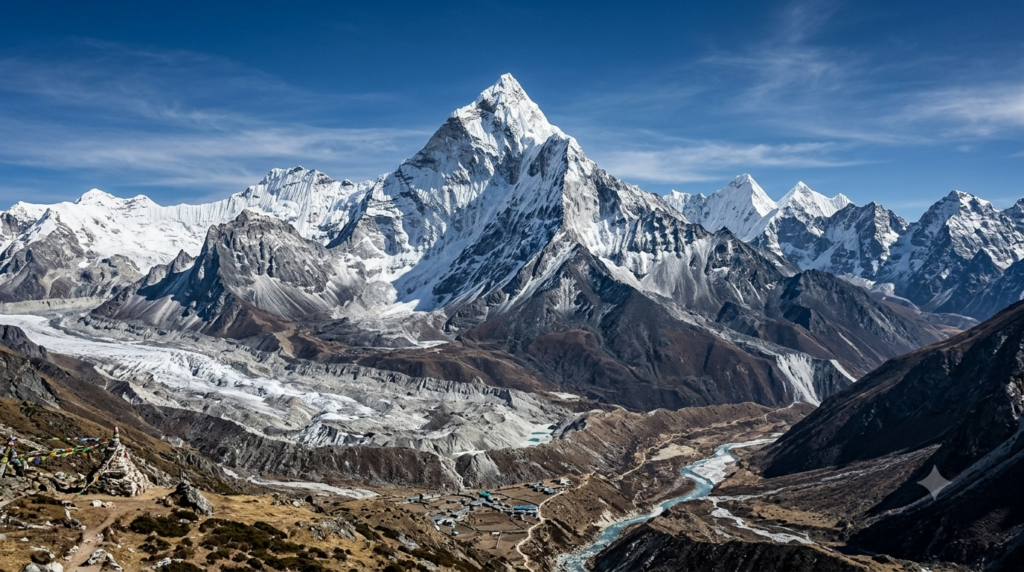
If you have ever stared at a map of the Himalaya and wondered how many 6000m peaks Nepal actually has, you are in good company. Most people know the eight-thousanders by name. Far fewer realise that the real depth of Nepal’s mountain landscape sits one tier below, in a huge, mostly unnamed crowd of summits between 6,000 and 7,999 metres. The 6000m peaks of Nepal range from friendly, crampon-and-rope introductions to the Himalaya to serious technical objectives that only a handful of teams attempt each decade.
This guide answers the big question first, then goes further: which 6000m peaks you can legally climb, how they are classified, what they cost, when to go, and how to choose one that matches your experience.

How Many 6000m Peaks Are There in Nepal?
Short answer: Nepal has well over a thousand peaks above 6,000 metres. The figure most commonly quoted is roughly 1,300, but no single number is universally agreed on.
Why the uncertainty? Three reasons:
- Definitions differ. Mountaineers disagree on what counts as a separate peak versus a sub-summit or shoulder of a larger mountain. A minimum “prominence” rule gives a smaller count than simply listing every named high point.
- Border peaks are shared. Many summits sit on the Nepal–Tibet (China) or Nepal–India frontier. Some lists include them in Nepal’s tally; others do not.
- Surveys are incomplete. Large parts of western Nepal, Humla, Dolpo and the far east have been only partly mapped. Many summits carry only a spot height and no name.
What this means for you: the number of 6000m peaks in Nepal is a useful headline, but the number that matters for climbers is how many are open to permits, and that is a much smaller list.
Quick Facts: 6000m Peaks in Nepal
| Question | Answer |
|---|---|
| Approximate number of peaks above 6,000 m | Around 1,300 (varies by source) |
| Officially opened trekking peaks (NMA) | About 33, split into Group A and Group B |
| Officially opened expedition peaks | Several hundred on the government list, updated periodically |
| Highest trekking peak | Mera Peak, 6,476 m |
| Most popular 6000m climb | Island Peak (Imja Tse), 6,189 m |
| Best seasons | Mid-March to May and late September to November |
Note: Government lists and permit rules are revised from time to time. Always confirm the current schedule with the Nepal Mountaineering Association (NMA) or the Department of Tourism before you book.
Why So Many 6000m Peaks Exist in Nepal
Nepal sits on the collision zone between the Indian and Eurasian plates, and the uplift is still ongoing. The result is a compressed, steep range where an eight-thousander is usually ringed by dozens of lesser giants. Climb a single valley such as the Khumbu, and you can see Ama Dablam (6,812 m), Cholatse (6,440 m), Island Peak (6,189 m) and Lobuche East (6,119 m) from nearby trails, all of them higher than anything in the European Alps outside Mont Blanc territory.
That density is why Nepal’s 6000m peaks are so attractive: you can often reach a genuine high-altitude summit in two to three weeks, with the logistics of a trek rather than a full expedition.
How Nepal Classifies Its 6000m Peaks
When people search “6000m peaks Nepal,” they usually mean one of two legal categories. The distinction affects cost, permits and the paperwork you need.
Trekking Peaks (NMA-Managed)
The NMA oversees about 33 peaks, divided into two groups:
- Group A: generally higher and more demanding, including Mera Peak and Island Peak.
- Group B: typically lower and less technical, though some still demand real glacier experience.
The term “trekking peak” is misleading. These are not walk-ups. Most involve glacier travel, fixed lines, steep snow or ice, and altitude that can shut down a fit climber who acclimatises poorly.
Expedition Peaks
The government maintains a longer list of expedition peaks, and permit fees are higher and often scale with the number of climbers. These include celebrated mountains like Ama Dablam and many remote summits in restricted or lesser-visited areas. Expect more paperwork, mandatory liaison officers on some peaks and a much higher logistics budget.
Unlisted and Restricted Peaks
The majority of Nepal’s 6000m peaks are not on any permit list. They remain unclimbed, closed, or simply never applied for. For most travellers this is irrelevant, but for experienced alpinists it explains why Nepal still offers genuine first-ascent potential.
The Best 6000m Peaks in Nepal for Climbers
Below are the summits that appear again and again in reputable itineraries, along with a realistic view of who each suits.
Mera Peak (6,476 m)
Often called the highest trekking peak, Mera is in the Hinku Valley, south of Everest. The summit day is long but largely non-technical, which makes it a favourite first 6000er. The risk is altitude, not climbing difficulty: you spend several nights above 5,000 m.
Island Peak / Imja Tse (6,189 m)
Island Peak is Nepal’s most popular 6000m climb, usually combined with the Everest Base Camp trek. The final headwall and a summit ridge give it real mountaineering character. It is a superb step up for anyone with a little rope and ice-axe experience.
Lobuche East (6,119 m)
Steeper and more technical than Island Peak, Lobuche East rewards you with a sharp rock-and-ice ridge and views of Everest, Nuptse and Lhotse. It suits climbers who want something more alpine.
Chulu West and Chulu East (6,419 m and 6,584 m)
Both lie in the Annapurna region. Chulu West is a classic acclimatisation-friendly climb, while Chulu East is longer and higher. They pair well with the Manang valley, which offers a quieter experience than Khumbu.
Pisang Peak (6,091 m)
A good Annapurna-region objective for those who want a shorter, steeper climb with reliable acclimatisation built into the approach.
Singu Chuli / Fluted Peak (6,501 m) and Hiunchuli (6,441 m)
Both sit close to the Annapurna Sanctuary. They are more demanding than the standard trekking peaks and typically attract climbers with previous Himalayan experience.
Ama Dablam (6,812 m)
One of the most beautiful peaks on Earth and an expedition-permit mountain. It is sustained, exposed and technical. It is not a first 6000er.

Comparison Table: Popular 6000m Peaks in Nepal
| Peak | Height | Region | Difficulty | Typical Duration |
|---|---|---|---|---|
| Mera Peak | 6,476 m | Hinku / Khumbu | Moderate (high altitude) | 16–20 days |
| Island Peak | 6,189 m | Khumbu | Moderate to challenging | 16–20 days |
| Lobuche East | 6,119 m | Khumbu | Challenging | 16–20 days |
| Chulu West | 6,419 m | Annapurna / Manang | Moderate to challenging | 18–22 days |
| Pisang Peak | 6,091 m | Annapurna / Manang | Moderate | 14–18 days |
| Ama Dablam | 6,812 m | Khumbu | Very challenging | 4–5 weeks |
Durations are typical commercial itineraries and vary by operator and acclimatisation plan.
How Hard Is It to Climb a 6000m Peak in Nepal?
Honestly, harder than most brochures suggest. The challenge is a combination of three things:
- Altitude. At 6,000 m the air holds roughly half the oxygen available at sea level. Even strong athletes can struggle.
- Cold and weather. Summit-day temperatures commonly drop well below minus 15°C, with wind making it feel colder.
- Technical skill. Glaciers, crevasses, fixed ropes and steep snow demand basic mountaineering competence.
What Fitness Do You Need?
You should be able to hike for six to eight hours with a light pack on consecutive days. Build a base of cardio and leg strength for at least three to four months before departure. Long hill hikes with a weighted pack are the single best preparation.
What Technical Skills Do You Need?
For the easier peaks, a short course on crampons, ice-axe use and rope work is enough. For steeper objectives like Lobuche East or Ama Dablam, prior alpine or glaciated experience is strongly advisable.
Best Time to Climb 6000m Peaks in Nepal
There are two reliable windows.
- Spring (mid-March to May): warmer, with longer days. Conditions can be busier, and afternoon cloud is common.
- Autumn (late September to November): stable weather, crisp visibility and the most popular season overall.
Winter climbing is possible on some peaks but is extremely cold. Monsoon (June to August) brings heavy cloud, rain and avalanche risk, although rain-shadow regions like Upper Mustang and Dolpo can still be viable for experienced teams.
Permits and Costs for 6000m Peaks in Nepal
Budgets vary widely, but the main components are consistent.
- Climbing permit: issued through the NMA for trekking peaks, or the Department of Tourism for expedition peaks. Fees depend on season, group size and peak category.
- National park or conservation fees: for regions like Sagarmatha National Park or the Annapurna Conservation Area.
- Guide and porter costs: a licensed climbing guide is strongly recommended and, for many peaks, expected.
- Equipment: crampons, harness, helmet, ice axe, high-altitude boots, down gear. Rental is available in Kathmandu and Namche.
- Insurance: mandatory in practice. Make sure your policy covers helicopter evacuation up to your maximum altitude.
Typical all-inclusive packages for popular peaks such as Island Peak or Mera Peak often fall in the range of a few thousand US dollars per person, depending on the operator, group size and inclusions. Treat any price far below the market range with caution, as it often means compromised safety, poor staff pay or inadequate equipment.
Expert Tips for Choosing and Climbing a 6000m Peak in Nepal
- Prioritise acclimatisation over speed. Itineraries with extra rest days have the highest summit success and the lowest sickness rates.
- Choose your operator carefully. Look for locally registered companies with clear safety protocols, staff insurance and transparent pricing.
- Train in your boots. Blisters at 5,500 m are miserable and avoidable.
- Pack for cold, not just altitude. Warm mitts, a quality down jacket and a good sleeping bag matter more than gadgets.
- Plan a buffer day. Weather can close a summit window. A spare day often decides whether you reach the top.
- Respect the mountain. Turn back when conditions or your body say so. The summit is optional, the descent is not.
Safety and Sustainability
Acute mountain sickness, frostbite and rockfall are the principal risks. Learn the symptoms of altitude illness and descend promptly if they worsen. Equally, high camps are fragile environments. Carry out your waste, choose operators who manage rubbish responsibly and pay porters and guides fairly. Climbing well means leaving the mountain, and the community that supports you, in good shape.
Frequently Asked Questions About 6000m Peaks in Nepal
How many 6000m peaks are there in Nepal?
Nepal has more than a thousand peaks above 6,000 metres, with a commonly cited figure of around 1,300. The exact total varies depending on how sub-summits and border peaks are counted. Only a small fraction are officially open to climbing permits.
What is the highest trekking peak in Nepal?
Mera Peak, at 6,476 metres, is generally regarded as the highest official trekking peak in Nepal. It is located in the Hinku Valley of the Khumbu region.
Can a beginner climb a 6000m peak in Nepal?
A fit beginner with the right training, a reputable guide and a proper acclimatisation schedule can attempt peaks like Mera Peak or Island Peak. Basic mountaineering skills are essential, and prior high-altitude trekking experience is a major advantage.
What is the best 6000m peak in Nepal for a first climb?
Mera Peak and Island Peak are the most common first choices. Mera is less technical but high, while Island Peak offers more climbing character and a famous summit headwall.
When is the best time to climb 6000m peaks in Nepal?
The best windows are spring (mid-March to May) and autumn (late September to November). These seasons offer the most stable weather and safest conditions.
Do you need a permit to climb 6000m peaks in Nepal?
Yes. Trekking peaks require a permit through the Nepal Mountaineering Association, while expedition peaks require a permit from the Department of Tourism. You will also need regional park or conservation fees.
How much does it cost to climb a 6000m peak in Nepal?
Costs depend on the peak, season, team size and services. Fully supported commercial climbs of popular 6000m peaks typically cost several thousand US dollars per person, including permits, guides, food and logistics.
How long does it take to climb a 6000m peak in Nepal?
Most popular climbs take between two and three weeks, including the approach trek, acclimatisation days, the summit push and the return. Expedition peaks take longer.
Conclusion: Your Next Step Among Nepal’s 6000m Peaks
The 6000m peaks of Nepal offer the ideal balance between adventure and achievement, making them a popular choice for climbers aiming to gain real Himalayan experience. While Nepal has around 1,300 peaks above 6,000 meters, the best peak for you is the one that matches your fitness, skills, and goals.
Once you’ve chosen your objective, focus on training, proper acclimatization, and climbing with an experienced operator. If you’re ready to plan your Himalayan climb, explore guided peak expeditions and trekking adventures with TrekYaari to find an itinerary that fits your ambitions and experience level.
Your journey to a Himalayan summit starts with choosing the right peak and taking the first step.