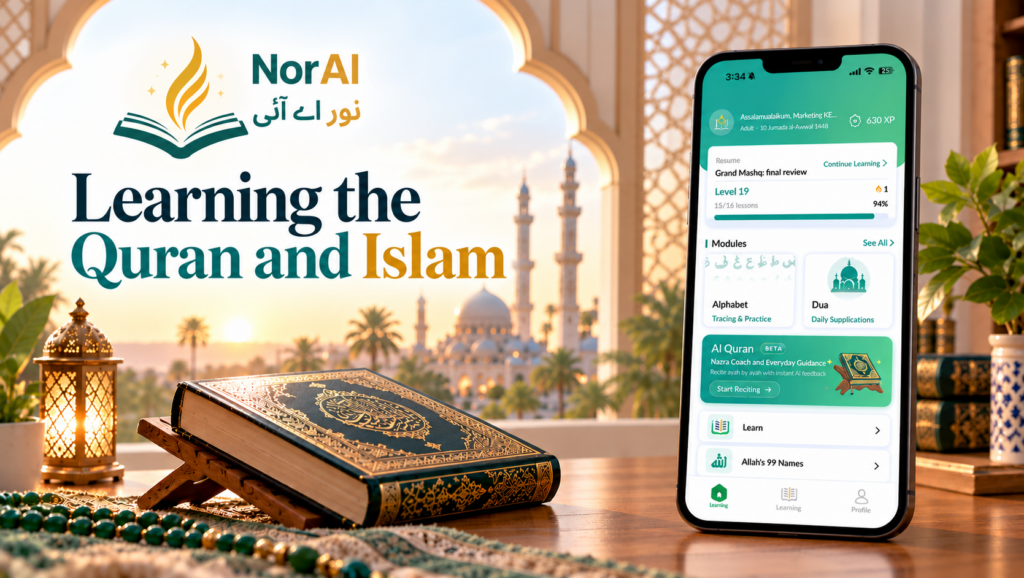
Learning the Quran and understanding Islam are important parts of a Muslim’s life. However, knowing where to begin can be challenging, particularly for beginners, busy adults and parents introducing Islamic education to their children.
Some learners want to recognise Arabic letters and improve their Quran reading. Others want to understand familiar Quranic words, learn Salah, practise daily duas or explore the foundations of Islamic belief.

The most practical approach is to build knowledge gradually, combining Quran learning with essential Islamic teachings.
This guide explains how children, adults and families can develop a structured learning routine, practise Quran recitation and become familiar with the beliefs and acts of worship that form part of everyday Muslim life.
What Is the Best Way to Learn the Quran and Islam?
The best starting point for beginners is to develop foundational Quran reading skills while gradually learning essential Islamic beliefs and practices.
A balanced learning approach includes:
- Recognising Arabic letters and Quranic words.
- Listening to and practising Quran recitation.
- Understanding simple Quranic vocabulary and meanings.
- Learning the five daily prayers.
- Becoming familiar with Wudu and Ghusl.
- Practising everyday supplications.
- Understanding Islamic beliefs and important acts of worship.
- Reviewing previously studied material regularly.
Rather than trying to learn everything immediately, learners can progress through a clear Quran learning pathway and explore Islamic subjects alongside their reading practice.
1. Begin With the Foundations of Quran Learning
For learners who have never studied Arabic, recognising letters and becoming familiar with their sounds is an important first step.
Arabic letters can appear differently depending on their position within a word. Learning these variations helps beginners recognise how letters connect.
What Should Beginners Learn First?
Beginners can focus on:
- Arabic alphabet recognition.
- Basic letter sounds and articulation.
- Short vowel marks.
- Connected letter shapes.
- Common Quranic words.
- Simple meanings.
- Listening and reading practice.
Short lessons followed by revision can make the learning process easier to manage.
It is also important to avoid rushing through unfamiliar letters. Practising a small number regularly helps learners build familiarity before moving on to more complex reading activities.
2. Follow a Structured 20-Level Quran Curriculum
A structured curriculum helps learners understand what they have studied and what comes next.
Without a clear sequence, beginners may move between unrelated lessons and struggle to identify their learning priorities.
The NorAI Quran Curriculum follows 20 structured levels organised into four main stages.
| Learning stage | Levels | Focus |
| Foundations | 1–5 | Building foundational learning skills |
| Recognition and Understanding | 6–10 | Developing word recognition and understanding |
| Practice and Patterns | 11–15 | Strengthening recognition through practice |
| Connections and Review | 16–20 | Recognising connections and revising previous learning |
A progressive curriculum provides direction without requiring every learner to follow the same pace.
Children may need additional repetition, while adults may prefer longer study sessions depending on their existing knowledge.
3. Use Different Activities to Support Quran Learning
Quran learning involves several connected skills, including recognising written Arabic, listening, pronunciation and remembering meanings.
Different activities can help learners practise these skills in manageable ways.
Visual Learning
Visual Learning helps learners recognise words and connect them with understandable visual examples.
Visual activities can be particularly useful when introducing unfamiliar vocabulary.
Audio Practice
Audio Practice gives learners opportunities to listen to Arabic pronunciation and become more familiar with spoken words.
Listening repeatedly can support recognition of unfamiliar sounds.
Articulation Practice
Articulation Practice focuses on how Arabic sounds are formed.
Learners can use articulation guidance alongside listening and spoken practice.
Writing Practice
Writing Practice introduces guided tracing to support Arabic letter recognition.
Combining reading and tracing provides another opportunity to revisit familiar letters.
Match Quiz
Match Quiz allows learners to review studied words and meanings through matching activities.
This helps reinforce connections between vocabulary and its meaning.
Word Joining
Word Joining supports recognition of how studied words connect at the appropriate stage of learning.
These activities are most useful when combined with consistent revision rather than treated as separate learning goals.
4. Improve Quran Recitation Through Listening and Practice
Learning to recite the Quran requires patience, attention and regular repetition.
Beginners may find certain Arabic sounds difficult because they do not exist in their first language.
A practical recitation routine can include:
- Listen carefully to a short ayah.
- Follow the written Arabic text.
- Recite the passage aloud.
- Identify words that are difficult to pronounce.
- Repeat the passage slowly.
- Return to the same passage for revision.
Can Digital Tools Help With Quran Recitation?
Yes. Digital learning tools can provide listening activities, repeated practice opportunities and feedback.
For example, NorAI Nazra Coach, currently in Beta, supports recitation practice across all 114 surahs.
Learners can listen to an ayah, recite it and review feedback indicating words that may need another attempt.
This can support independent practice, but automated feedback should not replace personalised correction from a qualified Quran teacher.
5. Understand Common Quranic Words and Meanings
Recognising Quranic words is an important part of developing familiarity with the Arabic text.
Beginners do not need to memorise a large vocabulary list immediately.
Instead, they can begin with words frequently encountered during learning.
A Simple Vocabulary Routine
- Select a small number of words.
- Listen to their pronunciation.
- Read their meanings.
- Practise recognising the written forms.
- Revisit the words during later lessons.
A Quran Glossary can also help learners understand common Quran-related and Islamic terms.
Learning vocabulary in a clear sequence can make revision more manageable.
6. Learn the Foundations of Islamic Beliefs
Alongside Quran reading, beginners should become familiar with the essential beliefs of Islam.
These provide a foundation for understanding worship and Muslim religious life.
The Six Articles of Faith
The six Articles of Faith are:
- Belief in Allah.
- Belief in His angels.
- Belief in His revealed books.
- Belief in His messengers.
- Belief in the Last Day.
- Belief in divine decree.
Learners can explore the Islamic Beliefs resource to become familiar with these concepts and related terminology.
Understanding the Six Kalimahs
The Six Kalimahs are commonly included in foundational Islamic education in many Muslim communities.
Studying their Arabic wording and meanings can complement learning about faith and worship.
The Kalimahs should be understood within their educational context rather than presented as a separate universally obligatory pillar of Islam.
7. Learn the Five Daily Prayers
Salah is a central act of worship in Islam.
Beginners can start by recognising the names of the five daily prayers and understanding their general times.
| Prayer | General time |
| Fajr | Dawn |
| Dhuhr | After midday |
| Asr | Afternoon |
| Maghrib | After sunset |
| Isha | Night |
Learning Salah also involves becoming familiar with its movements, recitations, conditions and sequence.
The Salah Learning Guide introduces the five daily prayers and provides educational guidance for beginners.
A gradual approach can help learners become familiar with the prayer sequence before moving towards more independent practice.
Exact prayer times vary by location and date. Learners should consult a reliable local timetable.
8. Understand Wudu and Ghusl Before Worship
Purification is an important part of Islamic practice.
Beginners should learn the difference between Wudu and Ghusl and understand when each is required.
What Is Wudu?
Wudu is ritual washing performed before Salah and certain other acts of worship.
Learners can study the sequence and essential actions through a Step-by-Step Wudu Guide.
What Is Ghusl?
Ghusl is full ritual purification required in particular circumstances.
A Ghusl Learning Guide helps beginners become familiar with its basic requirements and steps.
Both topics form part of the broader subject of Islamic Purification.
Questions involving personal circumstances or differences between schools of Islamic jurisprudence should be addressed through qualified religious guidance.
9. Make Daily Duas Part of Everyday Life
Daily supplications connect Islamic learning with ordinary activities.
Beginners can start with duas associated with familiar situations rather than attempting to memorise many at once.

Examples include:
- Waking up and sleeping.
- Eating and drinking.
- Entering and leaving home.
- Entering and leaving the mosque.
- Travelling.
- Seeking forgiveness.
- Seeking knowledge.
- Asking Allah for protection.
A practical example is the Dua Before Sleeping, which learners can review as part of their evening routine.
Families can also study the Dua Before Eating together before meals.
For a wider collection, the Daily Duas resource provides supplications with learning information.
When studying a dua, learners should aim to understand its meaning, pronunciation and appropriate context.
10. Explore the 99 Names of Allah
Studying the Names of Allah is an important part of learning about Islamic belief.
Each name introduces a meaning or attribute that helps learners become familiar with how Allah is described in Islamic teachings.
Examples include:
- Ar-Rahman: The Most Merciful.
- Ar-Raheem: The Especially Merciful.
- Al-Malik: The King.
- Al-Alim: The All-Knowing.
- Al-Ghafur: The All-Forgiving.
Learners can gradually explore the 99 Names of Allah, read their meanings and review them regularly.
Rather than focusing only on memorising names, it is valuable to understand their meanings through reliable educational sources.
11. Understand Fasting and Ramadan
Fasting during Ramadan is one of the Five Pillars of Islam.
For beginners, learning about Ramadan can start with understanding the daily fasting routine.
Important terms include:
Suhoor: The meal eaten before the fast begins.
Sawm: Fasting.
Iftar: The meal eaten when breaking the fast after sunset.
Learners can use a Fasting in Islam Guide to explore the basic principles of fasting, Ramadan and related practices.
Understanding these concepts can help children and adults develop familiarity with the purpose and structure of Ramadan.
12. Learn the Basics of Zakat
Zakat is an obligatory form of giving for Muslims who meet its applicable conditions.
Beginners should become familiar with essential terms such as:
- Nisab.
- Qualifying wealth.
- Zakat calculation.
- Eligible recipients.
- The applicable lunar-year requirement.
The Zakat Learning Guide provides educational information about these concepts.
Actual Zakat obligations depend on a person’s wealth, circumstances and applicable scholarly guidance.
13. Understand Hajj and Umrah
Hajj and Umrah are important forms of pilgrimage associated with Makkah.
Although they share certain practices, their requirements and religious status differ.
How Are Hajj and Umrah Different?
| Hajj | Umrah |
| Performed during specified days of Dhul Hijjah | Can generally be performed at other times of the year |
| Obligatory once in a lifetime for eligible Muslims | Its legal classification differs between schools of Islamic jurisprudence |
| Includes additional prescribed pilgrimage rites | Involves a shorter set of rites |
Beginners can study the stages of Hajj and Umrah separately before comparing their main practices.
The broader Hajj and Umrah Learning Resource introduces the key terms, stages and learning sequence associated with pilgrimage.
Educational resources help develop familiarity but should not replace qualified preparation for performing pilgrimage.
14. Connect Islamic Knowledge With Everyday Life
Islamic learning extends beyond individual acts of worship.
Muslims also learn about honesty, kindness, patience, gratitude, responsibility and respectful behaviour.
Families can introduce these values through ordinary situations, including:
- Speaking respectfully with others.
- Showing kindness to parents and relatives.
- Being truthful.
- Helping people in need.
- Practising patience during difficulties.
- Expressing gratitude.
The Everyday Guidance resource explores practical principles drawn from Quran and Sunnah learning.
Connecting these principles with daily routines can help learners recognise how Islamic teachings relate to their lives.
15. How Parents Can Support Quran and Islamic Learning at Home
Parents play an important role in creating a positive learning environment.
Children often benefit from manageable lessons, repetition and encouragement.
Practical Family Learning Activities
- Listen to a short Quranic passage together.
- Review a few familiar Arabic words.
- Practise an everyday dua.
- Discuss one Islamic learning topic.
- Revisit previously completed activities.
- Celebrate progress without comparing children.
Parents can also learn alongside their children.
The NorAI Family Learning resource explains how families can use supported learning features and parent-managed learner profiles.
Family learning should remain encouraging and suitable for each learner’s age and ability.
16. Choose Reliable Quran and Islamic Learning Resources
Choosing the right educational resources matters because accuracy and clear explanations are especially important in religious learning.
A useful resource should be transparent about its content, purpose and limitations.
| What to consider | Why it matters |
| Scholarly review | Supports accuracy and accountability |
| Structured learning | Provides an organised learning sequence |
| Audio support | Helps learners practise listening |
| Interactive activities | Provides different ways to review material |
| Clear meanings | Supports vocabulary understanding |
| Family controls | Supports parent-managed learning |
| Offline availability | Helps learners access supported downloaded materials |
| Transparent feature limits | Prevents unrealistic expectations |
Learners should distinguish between educational tools and qualified religious instruction.
For an overview of the available activities, the NorAI Learning Features page explains its supported practice methods.
17. How NorAI Supports Quran and Islamic Learning
NorAI is a Quran and Islamic learning platform designed for children, adults and families.
It combines a structured curriculum with visual activities, audio practice, word recognition, guided revision and educational content about essential Islamic topics.
Its learning resources cover Quran vocabulary, recitation practice, daily duas, Salah, purification, fasting, Zakat, pilgrimage and Islamic beliefs.
NorAI uses scholar-reviewed learning materials and provides an ad-free learner experience.
Supported offline lesson packs and audio downloads are available through eligible paid plans. Some features require internet access.
NorAI is free to start, while additional access is available through Individual and Family subscriptions.
Learners can review the available options on the NorAI Pricing page.
The platform is available on Android through Google Play and on iOS through the Apple App Store.
18. Build a Simple Weekly Quran and Islamic Learning Routine
A weekly routine can help learners balance Quran reading, recitation and Islamic knowledge.
| Day | Learning focus |
| Monday | Arabic recognition and Quran vocabulary |
| Tuesday | Quran listening and recitation |
| Wednesday | Salah and purification |
| Thursday | Daily duas |
| Friday | The 99 Names of Allah |
| Saturday | Islamic beliefs, fasting or Zakat |
| Sunday | Revision and family learning |
This is a suggested routine rather than a religious requirement.
Learners can adapt it according to their abilities, schedules and priorities.
Regular revision is usually more manageable than trying to cover every subject in one sitting.
Frequently Asked Questions
What should beginners learn first about the Quran and Islam?
Beginners can start with Arabic letter recognition, Quran listening, simple vocabulary, Islamic beliefs and the basic requirements of Salah. Learning gradually helps establish a foundation for further study.
Can adults start learning the Quran from the beginning?
Yes. Adults can begin with Arabic foundations and progress through structured reading, listening and revision activities according to their current ability.
How can parents help children learn the Quran?
Parents can encourage short daily practice sessions, listen to recitation together, review familiar words and use suitable educational resources. Consistency and encouragement are more helpful than unnecessary pressure.
What is the difference between Quran learning and Islamic learning?
Quran learning focuses on the Quran, including reading, recitation, vocabulary and understanding. Islamic learning covers broader subjects such as beliefs, Salah, purification, fasting, Zakat, duas and everyday religious guidance.
Can Quran learning apps help beginners?
Yes. Learning apps can provide structured lessons, audio, vocabulary activities and revision tools. They should complement, rather than replace, qualified instruction where personalised correction is required.
Is it possible to learn Quran and Islam at home?
Yes. Learners can study at home using reliable educational materials, audio resources, structured lessons and guidance from qualified teachers or scholars.
How long should beginners practise every day?
There is no fixed daily duration. Beginners may start with 10 to 15 minutes and adjust their routine according to their learning needs and available time.
Can Quran learning continue without internet access?
Some learning platforms offer supported downloadable lessons and audio. Offline availability depends on the platform, supported content and subscription plan.
Build a Strong Foundation in Quran and Islamic Learning
Learning the Quran and Islam is a gradual journey that benefits from patience, consistency and reliable educational guidance.
Beginners can start with Arabic recognition and listening practice before expanding into Quranic vocabulary, recitation and essential Islamic knowledge.
For families, creating a manageable learning routine can make religious education easier to include in everyday life.
A balanced approach combines understanding, practice and regular revision, helping children and adults continue learning at a pace that suits their abilities.