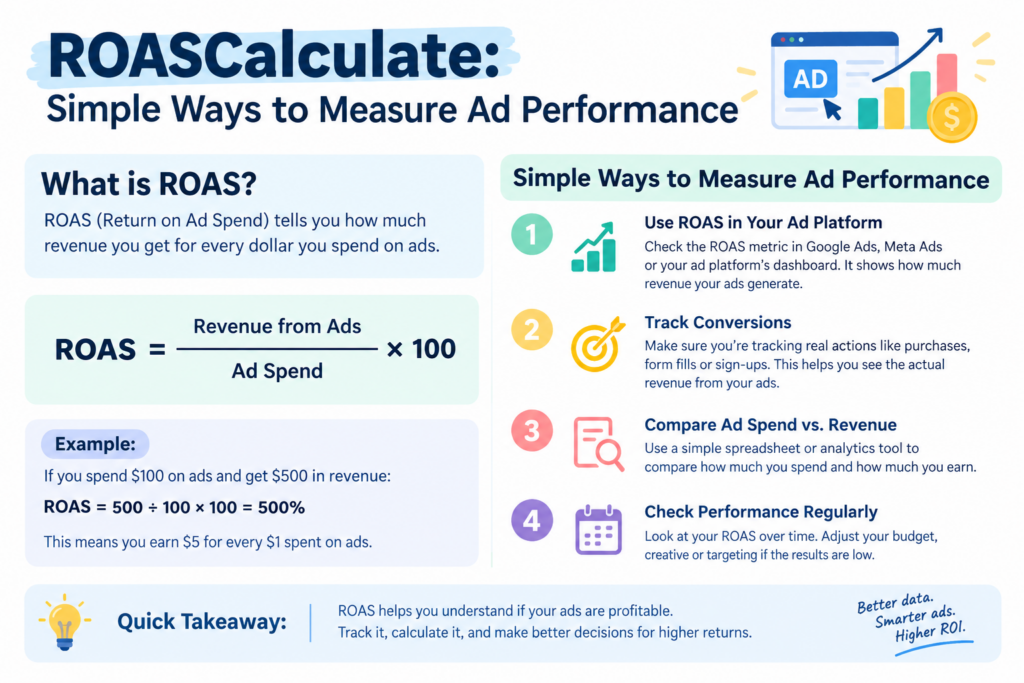
Digital advertising gives businesses access to measurable data, but collecting numbers is only the first step. Marketers also need to understand what those numbers mean and how they relate to campaign goals. Tracking impressions, clicks, conversions, revenue, and advertising costs can reveal which parts of a campaign are working and where changes may be needed. One practical metric is Return on Ad Spend (ROAS), which connects advertising costs with attributed revenue. With a consistent measurement process, businesses can review campaign performance and make decisions based on actual results. RoasCalculate provides a simple way to understand the calculations behind advertising performance.
What Is Ad Performance?
Ad performance describes how effectively an advertising campaign achieves its intended objectives. Depending on the campaign, the goal might be sales, leads, website visits, app installations, or another measurable action.

For ecommerce businesses, revenue and purchases are often key performance indicators. A lead-generation company may focus more on qualified leads and cost per lead. Therefore, marketers should select metrics that match the purpose of each campaign.
ROAS is particularly useful when the primary goal is generating revenue. It shows how much attributed revenue is produced compared with the money spent on advertising.
Understanding ROAS
Return on Ad Spend is commonly expressed as a ratio. For example, a campaign that spends $1,000 and generates $4,000 in attributed revenue has a ROAS of 4:1.
This means the campaign generated $4 in attributed revenue for every $1 spent on advertising.
ROAS can help marketers compare campaign results, but it does not represent net profit. A company may have additional expenses such as manufacturing, shipping, employee costs, payment processing, and software. These expenses should be considered separately when determining overall profitability.
How to Calculate ROAS
The basic calculation is straightforward.
ROAS = Advertising Revenue ÷ Advertising Cost
Suppose a company spends $2,500 on a campaign and generates $10,000 in attributed revenue.
$10,000 ÷ $2,500 = 4
The campaign therefore has a 4:1 ROAS.
Marketers can calculate ROAS for individual campaigns, advertising channels, products, or specific reporting periods. The key is to use consistent data when making comparisons.
Why the ROAS Formula Matters
The ROAS formula provides a simple framework for connecting advertising expenditure with campaign revenue. Instead of looking only at clicks or impressions, marketers can examine whether the campaign is generating measurable financial returns.
For example, Campaign A may receive 50,000 impressions and generate $3,000 in sales, while Campaign B receives 30,000 impressions and generates $5,000 in sales. The number of impressions alone does not explain which campaign produced more revenue efficiently.
Adding advertising costs to the analysis provides additional context. This is where the ROAS formula becomes useful.
Using a ROAS Calculator
A ROAS calculator can save time when marketers need to review campaign results regularly. Instead of manually performing the calculation for every campaign, users can enter the relevant revenue and advertising cost figures.
Consider the following examples:
Campaign A: $6,000 revenue ÷ $1,500 ad spend = 4:1 ROAS
Campaign B: $9,000 revenue ÷ $3,000 ad spend = 3:1 ROAS
Campaign C: $12,000 revenue ÷ $2,000 ad spend = 6:1 ROAS
These calculations provide a quick comparison. However, marketers should not rely on ROAS alone. Conversion volume, profit margins, customer value, and attribution settings can all affect how campaign results should be interpreted.
RoasCalculate can help users understand these calculations and create a consistent approach to measuring advertising results.

Track More Than One Advertising Metric
ROAS is useful, but strong campaign analysis usually requires several metrics. A marketer may track:
- Advertising spend
- Attributed revenue
- ROAS
- Conversion rate
- Cost per conversion
- Click-through rate
- Average order value
- Number of conversions
Looking at multiple metrics helps explain why a campaign is performing in a particular way.
For instance, a campaign may have a strong click-through rate but a low conversion rate. This could indicate that the advertisement attracts attention but the landing page or offer does not convert enough visitors.
The Role of an Ad Spend Calculator
An ad spend calculator can help marketers understand how much they are allocating to advertising and how spending relates to revenue targets.
Suppose a business has an advertising budget of $4,000 and wants to generate $16,000 in attributed revenue. The required ROAS would be:
$16,000 ÷ $4,000 = 4:1
This provides a measurable target for the campaign. Actual results may vary, so businesses should compare targets with historical performance and current market conditions.
Budget planning should also consider profit margins. A business with a low profit margin may require a different ROAS target from a business with a high-margin product.
Simple Ways to Improve Ad Performance
Improve Audience Targeting
Review audience data to determine which groups are generating conversions. Testing different audience segments can help identify where advertising produces meaningful results.
Test Different Ad Creatives
Try different headlines, images, videos, offers, and calls to action. Keep track of conversions and revenue rather than judging creative performance only by clicks.
Optimize Landing Pages
The advertising message and landing page should support the same customer intent. Clear information, relevant offers, and simple navigation can make it easier for visitors to complete the desired action.
Monitor Advertising Costs
Watch changes in cost per click and cost per conversion. If costs increase while revenue remains stable, overall advertising efficiency may decline.
Review Campaign Data Regularly
Consistent reviews can reveal trends that are difficult to see from a single day’s performance. Choose a reporting period that provides enough data for meaningful analysis.
Common Mistakes When Measuring Ad Performance
One common mistake is focusing on revenue without considering advertising costs. Another is treating ROAS as profit. Revenue generated by advertising still needs to cover other business expenses.
Inconsistent attribution can also create misleading comparisons. If one campaign uses a different attribution window from another, the reported revenue may not be directly comparable.
Small datasets can create another problem. A campaign with only a few conversions may show large changes in ROAS from one day to another. Waiting for more data can provide a clearer picture.
Conclusion
Measuring ad performance does not have to be complicated. Start with clear campaign goals, track advertising costs and attributed revenue, and use the ROAS formula to understand the relationship between spending and revenue. A ROAS calculator can simplify repeated calculations, while an ad spend calculator can support budget planning.
ROAS should be reviewed alongside conversion rates, customer value, profit margins, and other relevant metrics. With consistent measurement and regular testing, RoasCalculate can be a useful reference for marketers who want to understand campaign performance and improve their advertising analysis.
Frequently Asked Questions
1. What does ROAS measure?
ROAS measures attributed advertising revenue compared with the amount spent on advertising.
2. How do you calculate ROAS?
Divide attributed advertising revenue by advertising cost. For example, $5,000 divided by $1,000 equals a 5:1 ROAS.
3. What is a ROAS calculator?
A ROAS calculator helps users calculate advertising returns by entering revenue and advertising expenditure.
4. Is ROAS the same as profit?
No. ROAS measures revenue against advertising costs and does not include all other business expenses.
5. Why use an ad spend calculator?
An ad spend calculator can help businesses plan advertising budgets and compare spending with campaign revenue targets.