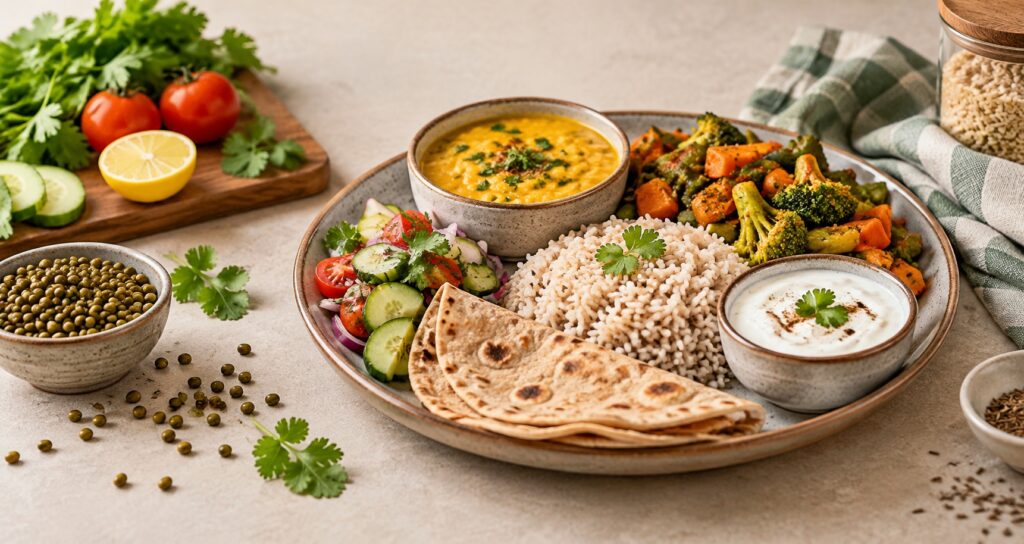
Eating a balanced diet does not mean changing everything you eat.
You don’t need to stop eating rice. You don’t need to give up roti. You don’t have to prepare separate “diet food” every day.

For most people, a balanced Indian meal is about making a few simple changes to the food they already cook.
Think about a normal lunch at home. It might be dal, rice, sabzi and curd. Or perhaps roti, vegetables and paneer. These meals can already provide several important nutrients.
The question is whether your plate has enough variety.
A simple way to look at your meal is to ask:
- Where is my protein?
- Where are my vegetables?
- Am I getting enough fibre?
- Is my portion of carbohydrates suitable for me?
- Am I including healthy fats?
You don’t need to get every meal perfect. What matters more is the overall pattern of your diet.
If you are looking for personalised guidance, a Dietitian in Bangalore can help you adjust familiar Indian meals according to your lifestyle, food preferences and nutritional needs.
What Does a Balanced Indian Meal Actually Mean?
A balanced meal contains a mix of nutrients that your body needs.
This usually includes:
- Carbohydrates for energy
- Protein for muscle and tissue maintenance
- Healthy fats
- Fibre
- Vitamins and minerals
- Adequate fluids
The exact amount you need depends on factors such as age, activity level, body size, health conditions and personal goals.
So there is no single plate that works for everyone.
For example, an office worker who spends most of the day sitting may have different needs from someone who exercises regularly or does physically demanding work.
This is why simply copying someone else’s diet plan often doesn’t work for long.
1. Add a Protein Source to Every Main Meal
One of the easiest ways to make an Indian meal more balanced is to check the protein.
Many traditional meals contain some protein, but the amount can vary.
For example, you could have:
- Dal
- Rajma
- Chole
- Moong
- Paneer
- Curd
- Eggs
- Fish
- Chicken
- Soy or tofu
- Sprouts
You don’t need to eat large portions of protein at every meal.
Instead, make it a regular part of your plate.
Simple Indian Meal Examples
Instead of:
Rice + pickle
Try:
Rice + dal + vegetable + curd
Instead of:
2 rotis + potato sabzi
Try:
2 rotis + mixed vegetable sabzi + dal or paneer
Instead of:
Plain dosa
Try:
Dosa + sambar + vegetable chutney
Small changes can make a familiar meal more complete.
What About Breakfast?
Breakfast is another place where protein often gets missed.
If your breakfast is mainly tea and biscuits, for example, you may feel hungry again fairly quickly.
You could try:
- Vegetable poha + peanuts + curd
- Idli + sambar
- Besan chilla + curd
- Eggs + roti + vegetables
- Vegetable upma + sprouts
- Paneer sandwich with vegetables
Choose what fits your eating pattern.
2. Add More Vegetables Without Making Separate Meals
Vegetables provide fibre, vitamins, minerals and other plant compounds.
But eating more vegetables doesn’t mean you need to prepare a complicated salad every day.
Indian cooking already gives you many options.
Try including:
- Palak
- Beans
- Carrot
- Bhindi
- Lauki
- Pumpkin
- Cabbage
- Cauliflower
- Peas
- Brinjal
- Capsicum
- Tomatoes
- Seasonal vegetables
You can add vegetables to dishes you already make.
For example:
- Add spinach to dal.
- Add peas and carrots to pulao.
- Add vegetables to poha.
- Add spinach or methi to roti dough.
- Add vegetables to an omelette.
- Add mixed vegetables to pasta or noodles.
This is usually easier to maintain than deciding that you will suddenly eat a huge salad every day.
3. Don’t Be Afraid of Rice or Roti
Carbohydrates are often the first thing people try to remove when they want to eat healthier.
But rice and roti can both fit into a balanced diet.
The more useful question is:
What are you eating with them?
A plate containing a large amount of rice and very little protein or vegetables will look very different nutritionally from a plate containing a moderate rice portion with dal, vegetables and curd.
The same applies to roti.
Roti + potato curry may provide a different balance from:
Roti + dal + vegetable sabzi + curd.
Try This Simple Method
Keep your usual carbohydrate, then add:
- One protein source
- One or two vegetable preparations
- Curd if you tolerate dairy
- A small amount of healthy fat
You don’t have to remove foods you enjoy just to create a healthier meal.
4. Include Healthy Fats in Reasonable Amounts
Fat has an important role in the diet.
Your body needs dietary fat for several functions, including helping absorb certain fat-soluble vitamins.
The goal isn’t to remove fat completely.
It is to pay attention to the type and amount.
Indian diets already contain several sources of fat, such as:
- Nuts
- Seeds
- Peanuts
- Sesame
- Coconut
- Ghee
- Vegetable oils
You don’t need to add multiple sources to every meal.
For example, if your sabzi already contains oil and you are having nuts as a snack, you may not need extra ghee simply because you have heard that ghee is “healthy.”
Portion still matters.
Simple Ways to Include Healthy Fats
You could:
- Add a small portion of nuts to breakfast.
- Use seeds in chutneys.
- Add ground flaxseed to curd.
- Use reasonable amounts of cooking oil.
- Include peanuts in poha or upma.
- Add sesame seeds to vegetables.
The idea is balance, not elimination.
5. Improve Fibre and Food Variety
Fibre is another part of the diet that deserves attention.
It can come from:
- Vegetables
- Fruits
- Whole grains
- Pulses
- Beans
- Nuts
- Seeds
One simple change is to stop eating the same few foods every day.
If your vegetable rotation is always potato, onion and tomato, try adding seasonal vegetables.
If you mostly eat white rice, experiment with other grains or rice varieties when they suit your preferences.
If you rarely eat fruit, add one whole fruit during the day.
You don’t need to change everything at once.
Why Food Variety Matters
Different plant foods provide different types of fibre and plant compounds.
You might eat:
Monday: Guava
Tuesday: Papaya
Wednesday: Orange
Thursday: Apple
Friday: Pomegranate
The same idea applies to vegetables and pulses.
A varied diet can be easier to build when you think in terms of weekly variety rather than trying to make every single meal completely different.
A Simple Indian Plate Formula
If you don’t want to count calories or weigh food, use a simple plate structure as a starting point.
Your main meal can include:
1. Carbohydrate
Choose one:
- Rice
- Roti
- Dosa
- Idli
- Poha
- Upma
- Millet
- Other grain-based foods
2. Protein
Choose one:
- Dal
- Rajma
- Chole
- Paneer
- Tofu
- Eggs
- Fish
- Chicken
- Curd
- Other suitable protein sources
3. Vegetables
Add one or more vegetable preparations.
4. Healthy Fat
Include a suitable amount through cooking oil, nuts, seeds or other food sources.
5. Fruit
You don’t necessarily need fruit with every meal. Include it elsewhere during the day if that works better for you.
This is not a strict formula.
Your requirements may be different.
How to Balance Common Indian Meals
Let’s make this practical.

Roti and Sabzi
Instead of:
Roti + potato sabzi
Try:
Roti + mixed vegetable sabzi + dal + curd
Rice and Dal
Instead of:
Rice + dal only
Try:
Rice + dal + vegetable + salad or another vegetable preparation
Dosa
Instead of:
Dosa + chutney
Try:
Dosa + sambar + vegetable chutney
Poha
Add:
- Peanuts
- Peas
- Carrots
- Other vegetables
You can pair it with curd if it suits you.
Khichdi
Khichdi can already contain grains and pulses.
You can add:
- Vegetables
- Curd
- A suitable side dish
Paratha
You don’t necessarily need to stop eating paratha.
Try pairing it with:
- Curd
- Vegetable sabzi
- Dal
- A protein-rich side
The goal is to improve the whole meal rather than label one food as good or bad.
What About Snacks?
Snacks can also affect how balanced your overall diet becomes.
If you usually reach for biscuits or fried snacks, try rotating some other options.
Ideas include:
- Fruit + nuts
- Roasted chana
- Curd with fruit
- Sprouts chaat
- Boiled eggs
- Peanut chaat
- Homemade vegetable sandwich
- Makhana in a suitable portion
You don’t have to completely eliminate your favourite snacks.
Having them occasionally while building better everyday habits is a more practical approach for many people.
How to Make Your Indian Diet More Balanced on Busy Workdays
A healthy meal plan can fail if it takes two hours to prepare.
This is where simple preparation helps.
You can:
- Cook a larger batch of dal.
- Wash and cut vegetables ahead of time.
- Keep roasted chana available.
- Boil eggs in advance if you eat them.
- Keep curd ready in the refrigerator.
- Prepare basic chutneys at home.
- Keep seasonal fruits where you can easily see them.
- Use leftover vegetables creatively.
For example, leftover sabzi can become a filling for a roti roll.
Leftover dal can become part of a vegetable dal soup.
Rice can be paired with eggs, paneer or vegetables the next day.
You don’t always need a new recipe.
Common Mistakes People Make When Trying to Eat a Balanced Diet
Removing carbohydrates completely
This can make meals unnecessarily restrictive.
Rice, roti and other carbohydrate foods can fit into a balanced diet.
Focusing only on calories
Two meals can have similar calories but very different amounts of protein, fibre and micronutrients.
Eating too little protein
If your meals are mostly rice, roti and vegetables, check whether you are getting enough protein from dal, beans, dairy, eggs or other suitable sources.
Adding too many “healthy” foods
More is not always better.
Nuts, seeds, ghee and dried fruits contain useful nutrients, but portions still matter.
Copying someone else’s meal plan
Your food preferences, schedule and nutritional needs may be different.
A plan that works for your friend may not fit your routine.
How a Dietitian in Bangalore Can Help
If you are confused about portions, protein intake, weight management or meal planning, working with a Dietitian in Bangalore can make the process more personalised.
A dietitian can review:
- Your current meals
- Eating schedule
- Food preferences
- Activity level
- Weight-related goals
- Medical history
- Dietary restrictions
- Nutritional requirements
Instead of giving you a completely unfamiliar menu, a personalised plan can work around the foods you already eat.
For example, if you eat rice every day, the solution may not be to remove rice.
The focus may be on portion size, protein, vegetables and the rest of the meal.
That small difference can make a diet much easier to follow.
A Simple 7-Day Way to Improve Your Meals
You don’t have to change your diet overnight.
Try one change each day.
Day 1
Add a protein source to breakfast.
Day 2
Add one extra vegetable to lunch.
Day 3
Add one whole fruit.
Day 4
Replace a highly processed snack with a simple whole-food option.
Day 5
Add a pulse-based dish such as dal, chole or rajma.
Day 6
Review your cooking oil, ghee and other added fats.
Day 7
Look at your meals from the entire week and identify what is missing.
Maybe protein is low.
Maybe vegetables are missing.
Maybe you rely heavily on packaged snacks.
Once you know the gap, you can work on it.
FAQs About Balanced Indian Meals
What is the best balanced Indian meal?
There is no single best Indian meal for everyone. A meal containing a suitable carbohydrate, protein source, vegetables and an appropriate amount of fat can be a useful starting point.
Can I eat rice every day and still have a balanced diet?
Yes. Rice can be included in a balanced diet. Pair it with protein-rich foods such as dal, beans, eggs, paneer, fish or chicken and include vegetables.
How much protein should I eat with each meal?
Protein needs vary from person to person. Your age, body size, activity level, health status and goals all matter. A qualified Dietitian in Bangalore can help estimate your individual needs.
Are roti and rice unhealthy?
Neither food is automatically unhealthy. The overall diet, portions, preparation and what you eat alongside them matter.
How can I make Indian breakfast healthier?
Add a protein source and vegetables where possible. Examples include idli with sambar, vegetable poha with peanuts and curd, or besan chilla with curd.
Small Changes Can Make Your Meals More Balanced
You don’t need a completely new kitchen or a complicated meal plan.
Start with your normal food.
Keep your rice if you enjoy it.
Keep your roti.
Keep your dosa and poha.
Then ask what the meal is missing.
Add protein.
Add vegetables.
Include fibre-rich foods.
Use healthy fats in sensible portions.
Bring more variety into your week.
That’s often a much more practical way to improve your diet than trying to follow a strict food list.
And if you are unsure what your body actually needs, a qualified Dietitian in Bangalore can help you build a plan around your routine rather than forcing your routine around a diet.