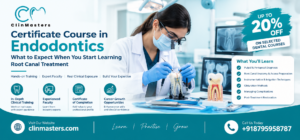
Root canal treatment is one of the most important procedures in restorative dentistry, yet it can be challenging for dentists who are beginning clinical practice. Accurate diagnosis, understanding root canal anatomy, maintaining asepsis, selecting appropriate instruments, and managing procedural complications require a combination of theoretical knowledge and practical skills.

A certificate course in endodontics provides a structured opportunity to strengthen these competencies and understand the clinical principles behind predictable root canal treatment. For BDS graduates and practising dentists, the right training programme can help bridge the gap between undergraduate education and the demands of everyday clinical practice.
When exploring dental courses after BDS, we should prioritise programmes that combine scientific understanding with practical exercises, case-based discussions, and appropriate clinical supervision. Learning root canal treatment is not simply about mastering a sequence of instruments; it is about making sound decisions at every stage, from diagnosis to the definitive restoration.
1. What Is a Certificate Course in Endodontics?
A certificate course in endodontics is a focused educational programme designed to develop knowledge and skills related to the diagnosis and management of pulpal and periapical conditions. Depending on the curriculum, it may cover foundational endodontic procedures, contemporary instrumentation systems, irrigation protocols, obturation techniques, and the management of common procedural difficulties.
Unlike a general overview of dentistry, an endodontic programme concentrates on the biological, anatomical, and technical principles that influence root canal treatment outcomes.
A well-structured course should help us understand:
- How to diagnose pulpal and periapical conditions.
- How to assess a tooth’s restorability and treatment prognosis.
- How to interpret clinical findings and dental radiographs.
- How to establish working length and understand canal anatomy.
- How to approach cleaning, shaping, and disinfection.
- How to select appropriate obturation techniques.
- How to recognise complications and determine when referral is necessary.
- How to plan the definitive restoration following endodontic treatment.
The course duration, practical components, eligibility criteria, and certification requirements vary between institutions. Before enrolling, we should review the syllabus carefully and determine whether it matches our current experience level.
2. What to Expect When Starting an Endodontics Course
When beginning an endodontics course, we should expect to revisit essential concepts before progressing to more advanced procedures. This approach helps establish a strong foundation and makes practical training more meaningful.
Understanding Pulpal and Periapical Diagnosis
Successful root canal treatment begins with an accurate diagnosis. Tooth pain does not automatically indicate that root canal treatment is required, and symptoms must be interpreted alongside clinical findings.
Training should cover patient history, pain characteristics, clinical examination, pulp sensibility testing, percussion, palpation, periodontal assessment, and radiographic interpretation.
We must learn to distinguish between different pulpal and periapical conditions while considering alternative causes of pain. A cracked tooth, periodontal condition, occlusal problem, or non-odontogenic pain may require a different management approach.
Learning Root Canal Anatomy
Root canal systems are often more complex than their radiographic appearance suggests. Variations in canal number, curvature, branching, and configuration can influence treatment difficulty.
A practical endodontic programme should explain how anatomical knowledge informs access preparation, canal location, instrumentation, and treatment planning.
Understanding these variations helps us recognise when a case requires magnification, additional imaging where justified, advanced techniques, or referral to an appropriately trained clinician.
3. Hands-On Training: From Demonstration to Practical Understanding
One of the most important aspects of a certificate course in endodontics is the opportunity to practise relevant techniques under appropriate supervision.
Observing an experienced clinician can clarify procedural steps, but practical exercises provide a different learning experience. They allow us to understand instrument handling, tactile feedback, access design, and the limitations of individual techniques.
Depending on the programme, hands-on training may include:
- Access cavity preparation on suitable training models.
- Identification and negotiation of simulated root canals.
- Working-length determination exercises.
- Manual and rotary instrumentation demonstrations.
- Irrigation techniques and safety principles.
- Obturation using appropriate training materials.
- Evaluation of prepared and filled canals.
- Case-based discussion of procedural errors.
Simulation exercises can help develop foundational hand skills before participants progress to appropriately supervised clinical activities.
We should ask the training provider how much time is allocated to practical work, how many participants share each workstation, and whether faculty members provide individual feedback.
4. Essential Skills Covered in Endodontics Courses
Different endodontics courses offer different levels of training, but several core competencies are central to learning root canal treatment.
Access Cavity Preparation
Access preparation provides entry to the pulp chamber and root canal system. We must understand tooth morphology, canal location, visibility, and the need to preserve sound tooth structure.
Inadequate access may make canal identification difficult, while excessive removal of tooth structure can compromise the tooth’s structural integrity. Training should emphasise a balanced approach based on the individual tooth and clinical situation.
Working-Length Determination
Establishing an appropriate working length is essential for controlled cleaning, shaping, and obturation.
Courses may explain the use of electronic apex locators, radiographic assessment, and the interpretation of relevant anatomical landmarks. We should understand the strengths and limitations of each method rather than relying on a single measurement without clinical evaluation.
Cleaning, Shaping, and Irrigation
Mechanical instrumentation helps shape the canal system, while irrigation supports the removal of debris and contributes to disinfection.
Training should cover instrument selection, glide-path principles, canal curvature, irrigation delivery, and measures to reduce procedural errors. Safe irrigation is particularly important because irrigants can cause tissue injury if delivered beyond the intended area.
Obturation and Coronal Restoration
Obturation aims to fill the prepared canal system appropriately after cleaning and disinfection. Courses may introduce different obturation materials and techniques, alongside the clinical considerations that influence their selection.

However, root canal treatment does not end when the canals are filled. The definitive restoration is important for maintaining the tooth’s function and reducing the risk of coronal leakage. Restorability, remaining tooth structure, occlusion, and the need for cuspal coverage must be considered when planning the final restoration.
5. Dental Courses After BDS: Is Endodontics the Right Choice?
For dentists exploring dental courses after BDS, endodontics can be a relevant option if they want to strengthen their ability to diagnose and manage pulpal disease and perform appropriate root canal procedures.
Before selecting a course, we should assess our current abilities and identify the specific areas that require improvement.
Newly qualified dentists may benefit from foundational instruction in diagnosis, isolation, access preparation, and working-length determination. Practising dentists may prefer programmes covering more complex anatomy, retreatment principles, or the recognition and management of procedural complications.
A certificate programme can support continuing education, but it does not automatically confer specialist status or establish competence to manage every endodontic case independently. Further supervised experience may be necessary, particularly when treating complex anatomy or managing complications.
6. Dental Courses in Noida: Choosing the Right Training Centre
Dentists researching dental courses in Noida can compare available programmes according to curriculum, faculty expertise, practical training, location, and professional goals.
When evaluating a dental training centre, we should look for transparent information about:
- Course duration and detailed syllabus.
- Faculty qualifications and relevant clinical experience.
- Practical exercises and clinical exposure.
- Supervision arrangements and patient safety.
- Batch size and opportunities for individual feedback.
- Assessment procedures and certificate requirements.
- Fees, materials, instruments, and additional expenses.
A dental academy in Delhi NCR may be a convenient option for dentists seeking professional training within the region. However, location should not be the only deciding factor. The quality of instruction and the relevance of practical learning are more important than promotional claims.
ClinMasters, based in Greater Noida, is one institution dentists can explore when researching clinical training opportunities. Visit clinmasters.com to review available programme information and confirm current course details directly with the institution.
7. How Endodontics Compares with Other Dental Training Options
Although endodontics is a valuable area of clinical development, it is not the only option available after BDS. We should select additional training according to our professional interests and the requirements of our practice.
A general dentistry course may help strengthen routine diagnostic, restorative, and treatment-planning skills. Other general dentistry courses may cover a wider range of procedures relevant to everyday practice.
A dental implant course focuses on implant-related diagnosis, patient selection, treatment planning, surgical principles, and restorative considerations. It requires a different skill set from endodontics and may involve additional supervised training.
Similarly, aesthetic dentistry courses and esthetic dentistry courses may cover smile analysis, shade selection, composite restorations, adhesive techniques, and minimally invasive aesthetic treatment.
For dentists seeking flexible professional development, short term dental courses India offers may provide focused instruction in individual subjects. The suitability of any programme depends on its syllabus, practical components, and the participant’s experience.
When comparing the best dental academy in Delhi or another dental academy in Delhi, we should focus on the specific skills we want to develop rather than choosing an institution based solely on the number of courses it advertises.
8. Common Mistakes to Avoid During Endodontic Training
Learning root canal treatment requires patience, consistent practice, and a willingness to recognise limitations.
Several mistakes can reduce the value of training:
- Focusing only on instruments: Successful treatment depends on diagnosis, anatomy, asepsis, irrigation, and restoration, not simply on using a particular instrument system.
- Rushing through practical exercises: Developing controlled hand movements and understanding procedural steps is more important than completing exercises quickly.
- Ignoring case selection: Not every tooth is suitable for straightforward treatment, and some cases require specialist assessment.
- Overlooking the final restoration: The long-term prognosis depends on the overall treatment plan, including appropriate restoration and follow-up.
- Assuming a certificate guarantees competence: Course completion should be followed by appropriate practice, feedback, and further learning.
- Failing to recognise complications: Understanding when to stop, reassess, seek assistance, or refer is an essential clinical skill.
A strong learning approach combines technical practice with critical thinking and patient-centred decision-making.
Conclusion
A certificate course in endodontics can provide a structured foundation for dentists who want to understand root canal treatment more thoroughly and strengthen their clinical skills. The most useful programmes connect diagnosis, anatomy, instrumentation, irrigation, obturation, and restorative planning through practical teaching and case-based learning.
Before enrolling, we should evaluate the curriculum, faculty expertise, hands-on opportunities, supervision, and assessment methods. We should also recognise that clinical competence develops progressively through appropriate training and experience.
By selecting an endodontics course that matches our current abilities and professional goals, we can make continuing education more purposeful and prepare ourselves to approach routine endodontic cases with better understanding, sound judgement, and a stronger commitment to patient safety.
Frequently Asked Questions
1. What is taught in a certificate course in endodontics?
A certificate course in endodontics commonly covers pulpal and periapical diagnosis, root canal anatomy, access cavity preparation, working-length determination, cleaning and shaping, irrigation, obturation, and restorative planning. Practical exercises and case discussions may also be included, depending on the programme.
2. Who should enrol in an endodontics course after BDS?
BDS graduates and practising dentists interested in strengthening their endodontic knowledge may consider an endodontics course. The programme should match their existing experience, with foundational training for beginners and appropriately designed advanced instruction for experienced practitioners.
3. Are dental courses in Noida suitable for learning root canal treatment?
Dental courses in Noida may provide opportunities to study root canal treatment through theoretical instruction, practical exercises, and supervised clinical learning. Before enrolling, we should verify the syllabus, faculty expertise, practical arrangements, and patient safety protocols.
4. How do we select the best dental academy in Delhi NCR for endodontic training?
We should compare curriculum quality, faculty qualifications, practical training, batch size, supervision, assessment methods, fees, and certification details. The most suitable dental academy in Delhi NCR is one that meets our specific learning needs and provides transparent information about its training programme.
5. Can a certificate course in endodontics prepare us to perform every root canal treatment independently?
No single certificate course should be assumed to prepare a dentist for every endodontic case. Competence develops through education, supervised experience, appropriate case selection, and continued professional development. Complex cases and complications may require referral to a suitably trained specialist.