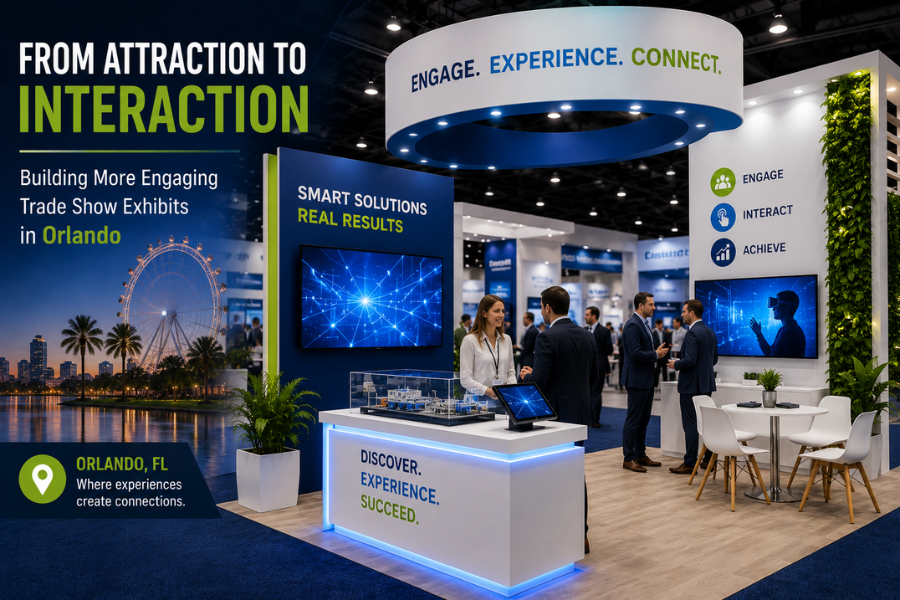
A successful trade show booth should do more than look attractive from the aisle. It should give visitors a reason to stop, interact with the brand, understand its products, and continue the conversation.
This is especially important for exhibitors participating in Orlando events where technology, entertainment, training, and immersive experiences play an important role. IAAPA Expo 2026 and I/ITSEC 2026, for example, serve very different audiences, but both create opportunities for exhibitors to use their booth as an experience rather than simply a product display.
For companies preparing for these events, working with a Trade Show Booth Builder in Orlando can help turn a basic exhibit concept into a visitor-focused environment that combines design, demonstrations, technology, graphics, meeting areas, and lead-generation opportunities.
The goal isn’t necessarily to build the largest booth.
It is to build a booth that people remember for the right reasons.
Why Interaction Matters
A visually impressive exhibit may attract attention, but interaction can create a stronger connection.
Visitors are more likely to remember a product when they have an opportunity to experience how it works instead of simply reading about it.
Depending on the industry, interaction could include:
- Live product demonstrations
- Touchscreen displays
- Virtual simulations
- Interactive product configurators
- Hands-on experiences
- Digital presentations
- Gamified activities
- Real-time demonstrations
However, technology should always have a purpose. Adding screens and interactive features simply to make the booth look modern can create unnecessary distractions.
Every interactive element should answer a question, demonstrate a benefit, or encourage a conversation.
Make the First Few Seconds Count
Trade show visitors move quickly through busy exhibition halls. Your booth needs to communicate its main message almost immediately.
The exterior should answer three basic questions:
Who are you?
What do you offer?
Why should visitors stop?
A large headline, strong product visual, demonstration, or architectural feature can become the initial attraction.
Once visitors enter, additional graphics and interactive displays can provide more detailed information.
This creates a simple communication flow:
Attract → Explain → Experience → Discuss
Keeping this sequence in mind can prevent the booth from becoming overloaded with disconnected elements.
IAAPA Expo: Turn the Booth Into an Experience
Entertainment and attractions are built around memorable experiences, making IAAPA Expo particularly suitable for experiential exhibit strategies.
For companies developing a trade show booth builder for IAAPA Expo 2026 strategy, the exhibit itself can demonstrate the type of experience the company provides.
For example, an attraction technology company could allow visitors to experience a small interactive feature. A technology provider could demonstrate a system through an immersive digital presentation. A manufacturer could create a hands-on product experience.
Instead of simply displaying photographs or specifications, the booth allows visitors to understand the product by experiencing it.
This can also give booth staff a natural way to begin conversations.
A visitor interacts with the display.
The representative explains how it works.
The visitor asks questions.
The discussion then moves toward the company’s products or services.
The booth becomes part of the sales process rather than simply the background for it.
I/ITSEC: Explain Complex Technology Clearly
I/ITSEC presents a different challenge.
Visitors may be interested in simulation, training, modeling, and advanced technologies. These solutions can be highly technical, which means exhibitors need to communicate capabilities without overwhelming visitors.
A trade show booth builder for I/ITSEC 2026 can help create spaces where technical products are explained through demonstrations and applications.
Instead of displaying a complicated system without context, demonstrate what problem it solves.
A simple structure can work well:
Challenge → Technology → Demonstration → Result
For example, visitors might first see a training challenge, then experience the simulation, and finally learn how the technology can improve training outcomes.
This approach makes complex solutions easier to discuss.
Design the Booth Around Visitor Flow
A booth should have a natural progression.
Consider dividing the exhibit into several functional zones.
Attraction Zone
This is the area visitors notice from the aisle. Use the strongest visual element and primary message here.
Discovery Zone
Visitors learn more about the company and its solutions through graphics, displays, or product information.
Experience Zone
This is where visitors interact with the product, demonstration, simulation, or technology.
Conversation Zone
Representatives can discuss requirements and answer initial questions.
Meeting Zone
Qualified prospects can move into a quieter area for more detailed discussions.
This type of zoning helps prevent congestion and gives visitors different ways to engage with the exhibit.
Don’t Overload the Booth With Technology
Technology can make an exhibit memorable, but too much technology can make the experience confusing.
Imagine a booth with multiple LED walls, touchscreens, virtual reality stations, digital presentations, and interactive displays all competing for attention.
Visitors may not know where to look.
Instead, select one or two major interactive experiences and make them the focus.
For example, a large display could attract attention while a touchscreen allows visitors to explore detailed information.
A simulation could become the main attraction while printed graphics explain its practical applications.
A Custom Booth Builder can integrate these elements into the architecture so the technology supports the booth rather than dominating it.
Design for Different Types of Visitors
Every visitor arrives with a different level of interest.
Some may only have a few seconds.
Others may want to explore your products.
Some may already know your company.
Others may be potential buyers actively researching solutions.
The booth should accommodate all of them.
A visitor with limited time should understand your primary message quickly.
A curious visitor should have something interesting to explore.
A serious prospect should have access to knowledgeable staff and a comfortable place to talk.
This layered approach makes the exhibit useful for both casual traffic and qualified leads.
Use Demonstrations as Conversation Starters
A product demonstration doesn’t need to explain everything.
Sometimes its most important job is to create curiosity.
A visitor sees the demonstration and asks a question.
That question gives the booth representative an opportunity to continue the conversation.
Instead of immediately approaching every visitor with a sales pitch, staff can use the demonstration as a natural opening.
Questions such as these can help:
- “Would you like to see how it works?”
- “Are you currently using a similar solution?”
- “Which part of the process are you most interested in?”
- “Would this type of technology fit your application?”
This creates a more natural interaction between the visitor and the brand.
Make Meeting Areas Comfortable
An interactive booth can generate traffic, but serious business conversations require a different environment.
If possible, separate meeting areas from noisy demonstrations and high-traffic sections.
Depending on the booth size, this could include:
- Open meeting tables
- Semi-private seating
- Private meeting rooms
- Acoustic partitions
- Dedicated consultation counters
The objective isn’t to isolate visitors completely.
It is to create enough comfort for meaningful conversations.
Make Graphics Support the Experience
Graphics should explain and reinforce the visitor experience.
Avoid covering every wall with paragraphs of information.
Instead, create a clear hierarchy.
Primary graphic: Main brand or product message
Secondary graphics: Benefits and applications
Interactive display: Detailed information
Meeting area: Case studies, technical information, or supporting content
This makes the booth easier to understand from a distance while still providing depth for visitors who want more information.
Connect Engagement With Lead Generation
Interaction is valuable, but the ultimate goal is usually business growth.
Your booth team should have a clear method for capturing useful visitor information.
Instead of collecting only names and email addresses, consider recording:
- Product interest
- Application
- Business need
- Purchase timeframe
- Follow-up preference
- Requested information
- Meeting requirements
QR codes and digital lead forms can simplify this process.
The important thing is to keep lead capture quick and relevant. Visitors shouldn’t have to complete a long form before receiving useful information.
Consider Flexibility When Planning the Exhibit
Companies participating in multiple trade shows may not need the same booth configuration for every event.
Different audiences can require different experiences.
A company may want an immersive setup for one event and a more technical demonstration-focused design for another.
Rental exhibits can provide flexibility, while custom exhibits can offer greater control over branding, architecture, and visitor experience.
The right option depends on your event schedule, booth size, budget, branding requirements, and long-term exhibition plans.
Plan Beyond the Booth Design
A successful exhibit requires more than a good rendering.
Companies should consider the complete exhibition process, including:
- Booth layout
- Graphics
- Lighting
- Electrical requirements
- Technology
- Furniture
- Product displays
- Storage
- Shipping
- Installation
- Dismantling
- On-site support
- Lead management
Planning these elements early can help avoid last-minute changes and ensure the final booth functions as intended.
Working with a Trade Show Booth Builder in Orlando can help coordinate these requirements as part of one overall exhibit strategy.
Final Thoughts
An effective Orlando trade show booth should create a reason for visitors to stop and interact.
IAAPA Expo demonstrates how immersive experiences can make a booth memorable, while I/ITSEC highlights the importance of making complex technology easier to understand.
Both approaches rely on the same principle:
Give visitors something valuable to experience.
Start with a clear message. Create a strong attraction from the aisle. Use demonstrations to explain your solutions. Keep technology purposeful. Provide comfortable spaces for conversations and make lead capture part of the overall visitor journey.
The best exhibit isn’t necessarily the one with the most features.
It is the one where every element has a clear purpose.
With the right Trade Show Booth Builder in Orlando, companies can create an environment that attracts attention, encourages interaction, supports meaningful conversations, and gives visitors a memorable reason to continue the relationship after the event.
Read more business blogs on Searchies Online