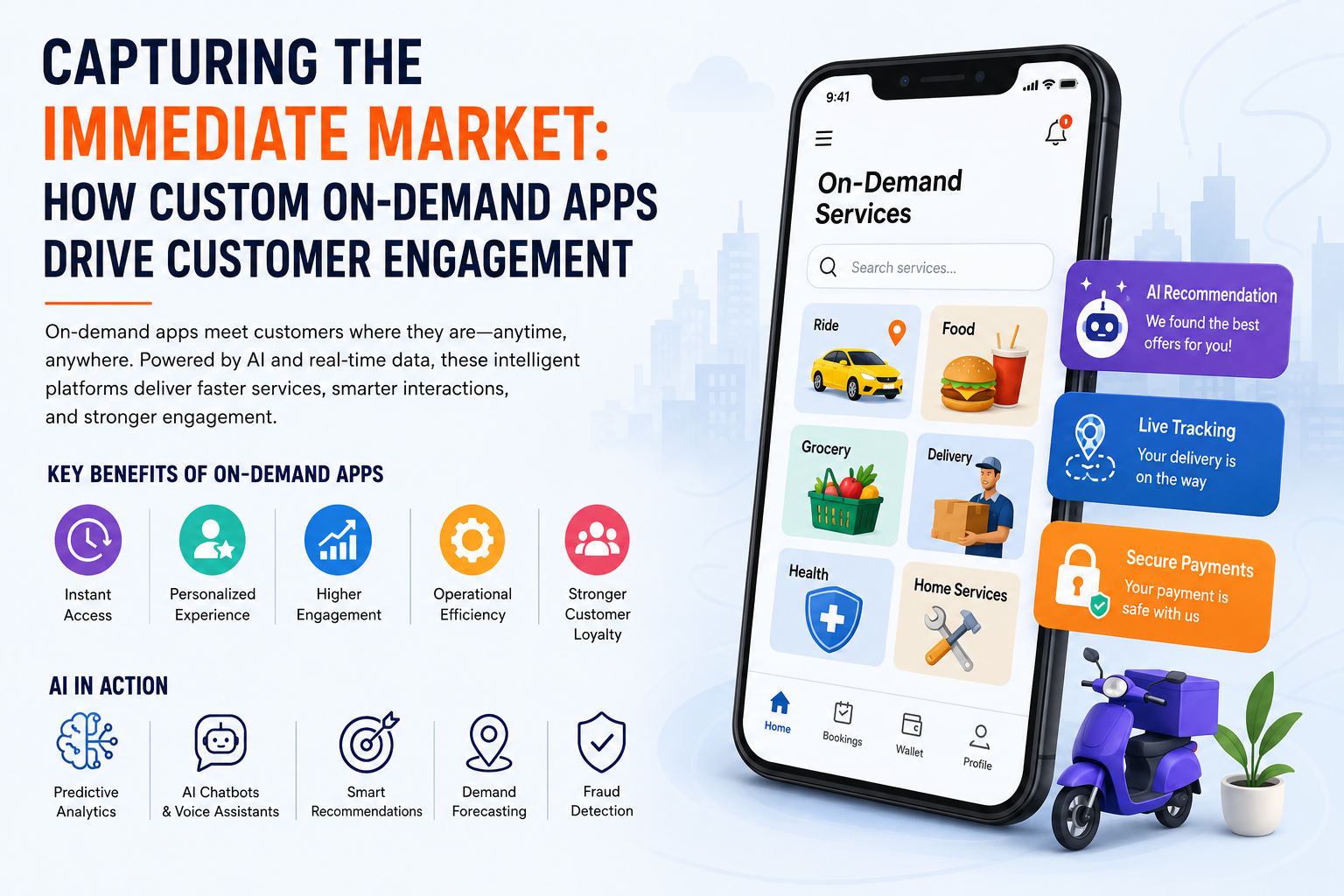
The Shift Toward Instant Customer Expectations
Customer behavior has changed dramatically in the digital era. People no longer compare businesses only by product quality or price. They compare speed, convenience, personalization, and how quickly a service responds to their needs.
Think about the last time you ordered food, booked transportation, scheduled a doctor appointment, or purchased a product online. The expectation was simple: a few taps, instant updates, and a smooth experience.
This shift has created a new business environment where companies need digital platforms that understand immediate customer requirements. Mobile applications have become a major channel for building direct relationships, collecting user insights, and improving engagement.
The rise of artificial intelligence (AI), automation, and advanced analytics has made these applications more adaptive. Instead of offering the same experience to every user, modern apps can predict behavior, recommend actions, and personalize interactions.
Why On-Demand Apps Are Changing Customer Engagement
Traditional business models often depend on fixed schedules, physical locations, or manual communication. On-demand platforms work differently. They connect users with services whenever the need appears.
A customer does not want unnecessary steps. They want solutions at the exact moment of demand.
For example:
- A fitness app can suggest workouts based on previous activity.
- A delivery platform can predict order timing based on customer habits.
- A healthcare application can provide reminders based on appointment history.
- A banking app can identify unusual transactions using machine learning models.
This level of responsiveness creates stronger engagement because the customer feels that the platform understands their situation.
The goal is not only to attract users. It is to create repeated interactions where the application becomes part of their daily routine.
The Role of AI in Modern On-Demand Applications
AI has become one of the strongest technologies influencing app development strategies. It allows applications to move from simple digital tools into intelligent systems.
Modern AI-powered features include:
| AI Technology | Role in On-Demand Apps | Customer Impact |
|---|---|---|
| Machine Learning | Predicts user preferences and behavior patterns | More personalized experiences |
| Natural Language Processing | Enables chatbots and voice assistants | Faster communication |
| Predictive Analytics | Forecasts demand and user actions | Better service availability |
| Recommendation Engines | Suggests relevant products or services | Higher engagement |
| Computer Vision | Supports image-based interactions | Improved automation |
For example, an AI recommendation system can analyze previous searches, purchases, location patterns, and browsing behavior. It then creates a more relevant experience for each user.
This is where businesses are moving beyond basic mobile applications. The focus is now on intelligent customer journeys.
How Businesses Approach Custom On-Demand App Development
Building an application for immediate customer needs requires more than creating a simple mobile interface. It involves understanding user behavior, business processes, data management, security, and scalability.
A modern on-demand app development company usually works around the idea of creating flexible platforms that can adapt to changing market demands. The technology approach often includes cloud infrastructure, API integration, AI-based automation, and real-time communication systems.
For organizations exploring custom solutions, custom on demand app development focuses on designing applications based on specific business workflows rather than using a generic structure. This approach helps address unique customer expectations, operational requirements, and industry-specific challenges.
A typical architecture may include:
- Mobile application layer
- Backend server system
- Database management
- AI processing engine
- Payment and communication integrations
- Analytics dashboard
The main objective is creating a connected ecosystem where users, businesses, and technology interact smoothly.
SEO and Visibility for On-Demand App Businesses
Having a powerful application is only one part of digital growth. Discoverability also matters.
Many businesses underestimate the role of SEO in app-driven markets. Users still search online before downloading an application or choosing a service.
For example, a person may search:
- “best food delivery app for local restaurants”
- “how to build an AI-powered healthcare app”
- “on demand service app development for startups”
These searches reveal user intent. SEO helps businesses understand what people are looking for and create content that matches those needs.
A strong SEO strategy for app-based businesses includes:
1. Search Intent Research
Understanding whether users are looking for information, comparisons, or solutions.
2. Technical Optimization
Improving website speed, mobile responsiveness, structured data, and indexing performance.
3. Content Development
Creating educational resources around industry problems, technology trends, and customer solutions.
4. User Experience Signals
Google considers factors such as engagement, usability, and page experience. A website connected with a useful application should provide consistent value.
SEO and app development now work together. The application creates engagement, while search visibility helps users discover the platform.
Building Smarter Customer Experiences Through Data
Every interaction inside an application creates valuable data.
A user clicks a product.
A customer cancels an order.
Someone searches for a specific service.
These actions provide insights.
AI systems can analyze this information to improve future experiences. For example, if data shows customers usually abandon a purchase during payment, businesses can simplify the checkout process.
A simple analytics workflow may look like this:
user_activity = {
    "search_history": ["fitness plan", "home workout"],
    "purchase_frequency": 5,
    "preferred_time": "evening"
}

if user_activity["purchase_frequency"] > 3:
    recommendation = "premium membership"

print(recommendation)
This example represents a basic logic model. Real-world systems use much larger datasets and advanced machine learning models to generate predictions.
The important point is that data-driven improvements help applications become more relevant over time.
Key Technologies Supporting On-Demand Platforms
The growth of these platforms depends on several technologies working together.
| Technology | Application in Modern Apps |
| Cloud Computing | Handles large-scale user activity |
| APIs | Connects different digital services |
| AI Models | Provides automation and predictions |
| Blockchain | Improves transparency in specific industries |
| IoT Integration | Enables connected device experiences |
Businesses are also exploring low-code development, voice interfaces, and AI assistants to reduce complexity and improve user interactions.
The future of digital services will likely depend on how effectively companies combine these technologies.
The Importance of Scalable Development Strategies
Customer demand can change quickly. An application that works for 1,000 users may face problems when it reaches 100,000 users.
Scalability becomes critical.
Modern on demand app development services focus on creating systems that can handle increasing users, transactions, and data without reducing performance.
Important scalability factors include:
- Optimized database structure
- Secure authentication systems
- Cloud-based infrastructure
- Efficient API management
- Performance monitoring
A well-designed application should not only solve today’s problems. It should support future growth.
Future Trends in On-Demand App Development
The next generation of digital applications will become more predictive and personalized.
Some emerging trends include:
- AI-powered personal assistants
- Hyper-personalized recommendations
- Voice-based app navigation
- Automated customer support
- Real-time demand forecasting
Companies are also exploring on demand app development solutions that combine automation, analytics, and intelligent decision-making.
The focus is moving from simply delivering services to creating experiences that anticipate user needs.
The Future of Customer Engagement Through Intelligent Applications
The future of on-demand platforms is moving toward smarter automation, predictive features, and personalized services. AI-driven applications will continue helping businesses create meaningful connections by understanding user needs before they are expressed. As competition increases, companies focusing on intelligent digital experiences will have better opportunities to maintain long-term customer relationships.
Final Thoughts
Customer engagement in the modern digital market depends on speed, relevance, and personalization. On-demand applications have changed how people interact with businesses because they provide services at the exact moment users need them.
AI has strengthened this transformation by making applications smarter and more responsive. When combined with strong SEO strategies, data analysis, and user-focused design, these platforms can create meaningful digital experiences.
The future belongs to applications that do more than respond. They understand, predict, and continuously improve.
Leave a Reply