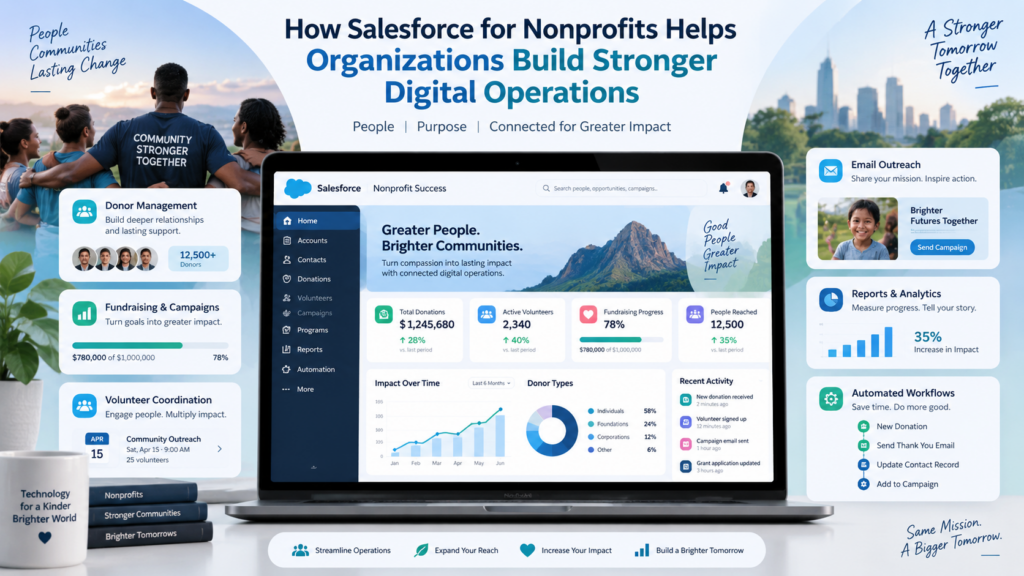
Nonprofit organizations are expected to create meaningful community impact while managing donors, volunteers, programs, fundraising campaigns, and day-to-day operations. As these responsibilities grow, relying on disconnected spreadsheets and manual processes can make it difficult to maintain accurate information and build lasting relationships.
This is where modern technology can make a significant difference. Salesforce for nonprofits provides organizations with a flexible platform for managing relationships, programs, fundraising, and data in one connected environment. When implemented strategically, it can help nonprofit teams spend less time managing information and more time focusing on their missions.
What Is Salesforce for Nonprofits?
Salesforce is a cloud-based customer relationship management (CRM) platform that can be adapted to the specific needs of nonprofit organizations. Instead of managing donor records, communications, volunteer information, and program data across separate systems, nonprofits can connect important information within a centralized platform.
A properly configured Salesforce environment can support areas such as:
- Donor and constituent relationship management
- Fundraising and donation management
- Volunteer engagement
- Grant and program management
- Marketing and communications
- Reporting and analytics
- Workflow automation
- Data management and integration
This flexibility makes Salesforce useful for nonprofits of different sizes and across different sectors. Organizations can develop technology systems around their existing processes while also creating a foundation for future growth.
Why Nonprofits Need Modern CRM Technology
Nonprofits often work with large amounts of relationship-based information. A single organization may communicate with donors, volunteers, beneficiaries, members, partners, grantmakers, and other stakeholders.
When this information is stored in separate databases or spreadsheets, teams may struggle to understand the complete relationship history of each constituent. Important details can become difficult to find, duplicated records may appear, and staff may spend valuable time performing repetitive administrative tasks.
Modern nonprofit CRM software helps address these challenges by bringing critical information together. Teams can create a more complete view of their constituents and use centralized data to support more consistent communication and decision-making.
For example, fundraising teams can use CRM data to understand previous interactions with donors, while program teams can access relevant information needed to manage services and outcomes. Leadership can use reporting tools to monitor organizational performance and identify areas that require attention.
Improving Donor and Constituent Relationships
Strong relationships are at the heart of nonprofit success. Donors and supporters want meaningful communication, transparency, and engagement rather than generic messages.
Salesforce can help nonprofits organize constituent information and track interactions over time. This can provide teams with better context when communicating with supporters.
Instead of treating every donor as an isolated transaction, organizations can build a broader picture of engagement. Donation history, event participation, communications, volunteer activities, and other interactions can be connected within the CRM.
This information can support more relevant engagement strategies. For example, an organization may identify supporters who regularly participate in events but have never made a donation and develop an appropriate communication strategy based on their interests.
Automating Repetitive Nonprofit Processes
Administrative work can consume significant time for nonprofit teams. Tasks such as updating records, sending reminders, assigning activities, generating reports, and managing follow-ups may require repetitive manual effort.
Automation capabilities within Salesforce can help organizations streamline these workflows.
For instance, an organization could create automated processes for acknowledging donations, assigning follow-up tasks, updating constituent records, or notifying staff when specific actions are required.
Reducing repetitive work can help teams improve operational consistency while allowing staff to dedicate more time to fundraising, programs, community engagement, and mission-focused activities.
Connecting Fundraising and Program Data
One of the challenges nonprofits face is understanding how fundraising activities connect with broader organizational outcomes. When information exists in isolated systems, creating a complete picture can be difficult.
A well-designed CRM environment can connect fundraising and constituent information with relevant organizational data. This allows nonprofit leaders to examine relationships between engagement, fundraising activities, programs, and outcomes.

Better-connected data can also support reporting. Instead of manually combining information from multiple spreadsheets, teams can use centralized data to develop reports and dashboards that provide useful operational insights.
Supporting Data-Driven Decision-Making
Nonprofits need accurate information to make informed decisions about resources, campaigns, programs, and stakeholder engagement.
Salesforce can provide reporting and analytics capabilities that help organizations turn operational data into actionable insights. Teams can monitor fundraising performance, constituent engagement, program activity, and other important metrics.
For example, nonprofit leadership may use dashboards to review donation trends, campaign performance, volunteer participation, or program activity. Having this information readily available can make it easier to identify changes and respond to emerging needs.
However, technology alone does not create better decisions. The quality of the underlying data and the way an organization structures its processes remain essential.
Choosing the Right Nonprofit CRM Software
Selecting nonprofit CRM software should begin with an organization’s goals rather than simply choosing the platform with the largest number of features.
Before implementing a CRM, nonprofits should consider questions such as:
- What information needs to be centralized?
- Which processes currently require the most manual work?
- What reporting does leadership need?
- How should fundraising and constituent engagement be managed?
- Which existing tools need to integrate with the CRM?
- What will the organization need as it grows?
These questions can help create a clearer technology strategy and prevent organizations from implementing unnecessary complexity.
Successful CRM adoption also requires staff training, clear processes, data governance, and ongoing optimization. A platform should evolve as organizational needs change.
Building a Sustainable Digital Foundation
A CRM implementation should not be viewed as a one-time technology project. Nonprofits operate in changing environments, and their technology needs can evolve as programs expand, fundraising strategies change, and stakeholder expectations develop.
A scalable platform can provide a foundation that organizations can continue to improve over time. Integrations, automation, reporting, and customized workflows can be introduced as needs become clearer.
The goal is not simply to add another software system. It is to create an interconnected digital environment that supports people, processes, and mission outcomes.
How Cloud for Good Supports Nonprofit Organizations
Implementing Salesforce successfully requires more than configuring software. Nonprofits need a strategy that connects technology with organizational goals and operational realities.
Cloud for Good helps nonprofit organizations leverage Salesforce to create technology solutions aligned with their missions. As a Salesforce implementation partner focused on mission-driven organizations, Cloud for Good brings experience across nonprofit, higher education, healthcare, public sector, and other sectors.
With thousands of implementations delivered, the team works with organizations to improve processes, connect data, strengthen constituent engagement, and build scalable Salesforce environments.
Final Thoughts
For nonprofits looking to modernize their operations, Salesforce for nonprofits can provide a powerful foundation for connecting people, processes, and data. From fundraising and donor relationships to program management, automation, and reporting, a well-designed CRM can help organizations operate more efficiently.
The most successful implementations begin with a clear understanding of the organization’s mission and needs. By combining the right nonprofit CRM software with thoughtful strategy, strong data practices, staff adoption, and ongoing optimization, nonprofits can build a sustainable digital foundation that supports their teams and the communities they serve.
As nonprofit organizations continue to embrace digital transformation, platforms such as Salesforce can play an important role in helping them turn better-connected data and processes into stronger organizational impact.