Author
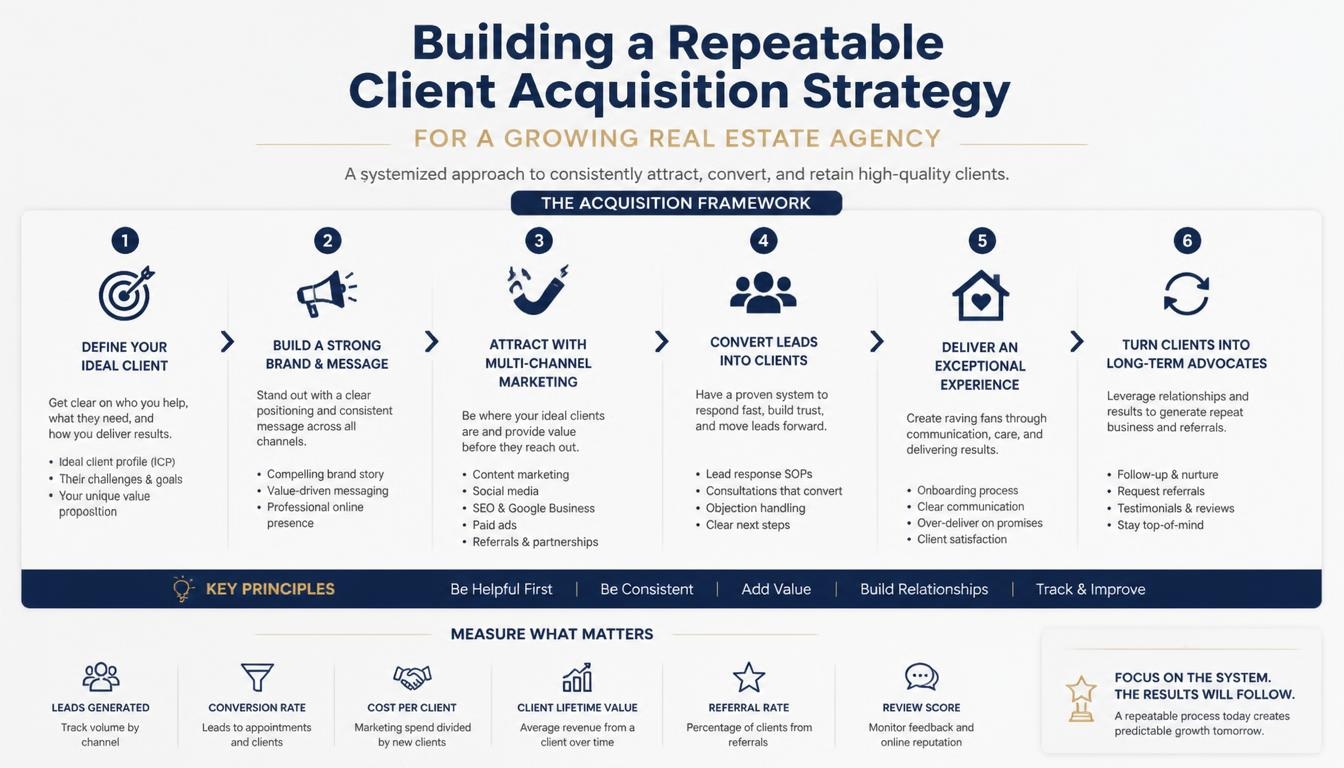
Growing a real estate agency is not just about closing more property deals. It is about creating a reliable system that consistently attracts potential buyers and sellers, builds meaningful relationships, and converts interested prospects into long-term clients. While referrals and word-of-mouth recommendations remain valuable sources of business, depending entirely on them can make growth unpredictable.
Many real estate agencies experience periods of strong inquiries followed by quieter months. This inconsistency often happens because they lack a structured approach to attracting and managing potential clients. Without a clear acquisition process, agents may spend too much time chasing unqualified prospects, following up manually, or investing in marketing activities that produce little return.
A repeatable client acquisition strategy helps solve this challenge. It gives agencies a practical framework for reaching the right audience, generating relevant inquiries, nurturing relationships, and converting opportunities into successful transactions.
Whether you operate a small independent brokerage or manage a growing real estate agency, developing a consistent acquisition system can help you improve marketing efficiency, strengthen your sales pipeline, and support sustainable business growth.
1. Define Your Ideal Client Before Investing in Marketing
One of the biggest mistakes real estate agencies make is trying to attract everyone. Buyers, sellers, landlords, tenants, property investors, and commercial clients all have different expectations and requirements.
A marketing campaign designed for first-time homebuyers may not appeal to experienced property investors. This is why real estate lead generation services focus on identifying and targeting different audience segments with tailored marketing strategies. Similarly, homeowners considering selling their properties need different information from people searching for rental accommodation.
Start by identifying the specific audience your agency wants to serve.
Consider factors such as:
- Location: Which cities, neighborhoods, or property markets do you specialize in?
- Property preferences: Do you focus on residential homes, apartments, luxury properties, commercial spaces, or investment properties?
- Budget range: What price categories align with your agency’s services?
- Client motivation: Are your prospects buying their first home, upgrading, relocating, selling, or investing?
- Decision-making challenges: What concerns prevent them from taking the next step?
Creating detailed client profiles helps your team understand whom they should target and what messaging will attract their attention.
For example, an agency specializing in residential properties could create separate audience profiles for first-time buyers, families looking for larger homes, and investors seeking rental income opportunities.
This segmentation makes marketing more relevant and improves the chances of attracting prospects who genuinely need your services.
2. Build a Strong Digital Presence That Establishes Trust
Potential clients frequently research real estate agencies online before making contact. They compare property listings, read reviews, explore websites, and evaluate an agency’s local market knowledge.
Your digital presence should make it easy for prospects to understand what your agency offers and why they should choose your team.
Start with a professional, mobile-friendly website that communicates your services clearly. Include essential information such as property listings, agent profiles, service locations, client testimonials, and contact details.
Your website should also provide useful information that answers common questions.
Consider publishing content about:
- Local property market trends and pricing updates.
- Neighborhood guides and community information.
- Home-buying and selling processes.
- Property investment considerations.
- Tips for preparing a home for sale.
- Frequently asked questions about real estate transactions.
Educational content positions your agency as a knowledgeable resource rather than simply another business advertising available properties.
Search engine optimization (SEO) also plays an important role. Optimize website pages around relevant local searches, such as property agents in your service areas, homes for sale in specific neighborhoods, and local property market advice.
Include descriptive page titles, useful headings, relevant internal links, and location-specific information.
A strong digital presence helps your agency attract people who are already researching property-related services and gives them a reason to trust your expertise.
3. Use Targeted Campaigns to Attract Relevant Prospects
Online advertising can help real estate agencies reach potential clients who may not discover their services through organic search alone.
However, successful campaigns require more than simply promoting property images and hoping people submit inquiries.
Start by identifying the purpose of each campaign. Are you trying to attract homeowners interested in selling, buyers searching for residential properties, or investors exploring opportunities?
Once the objective is clear, select the appropriate advertising platforms.
Google Ads: Search campaigns can connect your agency with people actively looking for property-related services. Someone searching for a property consultant in a particular location may have stronger immediate intent than someone casually browsing social media.
Facebook and Instagram Ads: These platforms can help agencies introduce their services, showcase listings, promote informative content, and reach relevant audience segments.
LinkedIn: Agencies specializing in commercial real estate or investment-related services may find opportunities to connect with business owners and professionals.
YouTube: Property walkthroughs, neighborhood videos, and educational content can help build familiarity and trust.
Each campaign should have a clear message, relevant visuals, and a specific next step. Instead of using generic advertisements, highlight a meaningful benefit, such as receiving a property valuation, exploring suitable listings, or arranging a consultation.
Most importantly, monitor the quality of incoming inquiries rather than judging campaign performance solely by the number of leads generated.
A campaign producing fewer but more relevant prospects may deliver better business results than one generating hundreds of unqualified submissions.
4. Create Landing Pages That Turn Interest Into Inquiries
Sending every advertising visitor to your homepage can reduce conversion opportunities.
A dedicated landing page provides a more focused experience by matching the advertisement’s message with the information visitors want.
For example, a campaign promoting residential property consultations should direct visitors to a page specifically explaining that service.
An effective landing page should include:
- A clear and benefit-focused headline.
- A short explanation of the service.
- Relevant property images or supporting visuals.
- Information about your agency’s experience.
- Testimonials or trust indicators.
- A simple inquiry form.
- A visible call to action.
Avoid asking visitors to complete unnecessarily long forms. Request only the information your team needs to begin a meaningful conversation.
For example, a buyer inquiry form might ask for their preferred location, property type, approximate budget, and contact information.
For homeowners interested in selling, you might request the property location, property type, and an estimated selling timeline.
The objective is to reduce friction while collecting enough information to understand the prospect’s requirements.
Test different headlines, calls to action, images, and form layouts to identify which combinations produce the best results.
5. Develop a Lead Qualification Process
Not every inquiry represents an immediate sales opportunity. Some prospects are ready to make a decision, while others are still researching their options.
Without a qualification process, agents may spend valuable time pursuing inquiries that have little potential to convert.
Develop a consistent method for understanding each prospect’s needs and readiness.
Your qualification process could consider:
Budget: Does the prospect have a realistic budget for the properties or services they are exploring?
Timeline: Are they planning to purchase or sell immediately, within a few months, or sometime in the future?
Requirements: What location, property size, features, or investment objectives matter most?
Readiness: Have they already explored financing, shortlisted properties, or spoken with other professionals?
Decision-making authority: Is the person contacting your agency directly involved in the transaction?
Use these details to categorize inquiries according to their level of readiness.
For instance:
- Hot prospects are actively looking to buy or sell and are ready for direct engagement.
- Warm prospects have genuine interest but need additional information or time.
- Cold prospects are exploring possibilities without an immediate intention to transact.
This classification helps agents prioritize their daily activities and create more relevant follow-up plans.
Remember that a prospect who is not ready today may become an important client later. Qualification should guide communication, not result in dismissing potential opportunities prematurely.
6. Implement a CRM System to Manage Every Opportunity
A customer relationship management (CRM) system is essential for creating a repeatable acquisition process.
As an agency grows, managing inquiries through spreadsheets, personal email accounts, and individual messaging applications becomes increasingly difficult.
Important conversations can get overlooked, follow-ups may be delayed, and managers can lose visibility into the sales pipeline.
A CRM provides a centralized location for storing and managing prospect information.
A well-organized system should allow your team to:
- Record inquiries from different marketing channels.
- Store contact details and property preferences.
- Assign prospects to the appropriate agents.
- Track communication history.
- Schedule reminders and follow-up activities.
- Monitor opportunities through different sales stages.
- Review individual and team performance.
For example, when someone submits a property inquiry through your website, their details can automatically enter your CRM.
The assigned agent can receive a notification, review the prospect’s requirements, and schedule an initial conversation.
As the relationship develops, the agent can update the prospect’s status, record important information, and plan the next interaction.
This creates consistency across the agency and reduces dependence on individual agents remembering every detail.
A CRM also makes it easier for management to identify bottlenecks and understand which acquisition channels generate meaningful business opportunities.
7. Build a Consistent Follow-Up and Lead Nurturing Process
Generating an inquiry is only the beginning of client acquisition. Many prospects need multiple interactions before they feel comfortable making a decision.
Unfortunately, some agencies lose potential business because they fail to maintain consistent communication.
Create a structured follow-up process that ensures every inquiry receives an appropriate response.
A simple nurturing sequence could look like this:
First interaction: Acknowledge the inquiry, introduce your agency, and understand the prospect’s requirements.

Second interaction: Share relevant property options, service information, or answers to their initial questions.
Third interaction: Provide additional guidance based on their preferences and ask whether their requirements have changed.
Ongoing communication: Share useful market updates, new listings, neighborhood information, and other relevant resources.
The frequency and content of communication should depend on the prospect’s preferences and readiness.
Avoid sending repetitive sales messages that offer little value. Instead, make every interaction useful.
For example, a buyer searching for an apartment may appreciate updates about suitable listings, local amenities, and financing considerations.
A homeowner considering selling may find property valuation insights, preparation tips, and recent neighborhood sales more relevant.
Email marketing and approved messaging channels can support this process. However, communication should always respect privacy requirements, consent, and the recipient’s preferences.
The objective is to remain helpful and accessible until the prospect is ready to take the next step.
8. Strengthen Your Local Marketing and Referral Network
Real estate is closely connected to local relationships. People often prefer working with professionals who understand their neighborhood, property values, and community developments.
This makes local marketing an important component of a sustainable acquisition strategy.
Start by optimizing your Google Business Profile with accurate business information, service areas, photographs, contact details, and regular updates.
Encourage satisfied clients to share honest reviews about their experiences. Positive feedback can strengthen your reputation and help potential customers evaluate your agency.
You can also build relationships with professionals whose services complement your own.
These may include:
- Mortgage brokers and financial professionals.
- Property lawyers and legal consultants.
- Home inspectors and valuation specialists.
- Interior designers and renovation contractors.
- Relocation consultants.
- Local business owners and community organizations.
Developing a professional referral network creates opportunities to connect with people who may need real estate assistance.
You can also organize local property information sessions, neighborhood events, or educational webinars.
These activities help your agency become more visible within its target market and create relationships that may generate future business.
9. Turn Social Media Into a Relationship-Building Channel
Social media should do more than display available properties.
It gives your agency an opportunity to demonstrate expertise, communicate its personality, and build familiarity with potential clients.
Develop a content calendar that balances promotional and educational material.
For example, your agency could publish:
- Property walkthrough videos.
- Local market updates.
- Neighborhood highlights.
- Buyer and seller tips.
- Frequently asked real estate questions.
- Client success stories shared with permission.
- Behind-the-scenes content featuring your agents.
- Short explanations of common property-related challenges.
Video content can be especially useful because it allows prospects to see properties, understand locations, and become familiar with the people representing your agency.
Encourage meaningful engagement by responding to questions and comments professionally.
You can also repurpose longer blog articles into short videos, infographics, and social media posts.
This approach helps your team maintain a consistent publishing schedule without creating every piece of content from scratch.
The main objective is to establish your agency as an approachable and knowledgeable resource within the local property market.
10. Track Performance and Measure What Actually Matters
A repeatable acquisition strategy should be measurable.
Without performance tracking, agencies may continue investing in marketing activities that generate attention but fail to produce valuable business opportunities.
Identify key performance indicators (KPIs) that connect marketing activity with actual sales outcomes.
Important metrics include:
Inquiry volume: How many new prospects enter your acquisition system each month?
Cost per lead: How much does your agency spend to generate an individual inquiry?
Lead-to-appointment rate: What percentage of prospects agree to a consultation or property viewing?
Appointment-to-client rate: How many meetings result in an active client relationship?
Client acquisition cost: What is the overall cost of converting a prospect into a new client?
Conversion rate: What percentage of qualified opportunities eventually result in completed transactions?
Marketing channel performance: Which sources generate the highest-quality prospects?
For example, social media advertising may produce a high volume of inquiries, while organic search generates fewer inquiries but a higher percentage of serious prospects.
Tracking these differences helps your agency allocate its marketing budget more effectively.
Review performance monthly and identify areas that require improvement.
If inquiries are high but appointments are low, your qualification or follow-up process may need attention. If appointments are increasing but transactions remain limited, review your sales conversations, property matching process, and client experience.
Use actual performance data to guide decisions rather than relying on assumptions.
11. Standardize Your Acquisition Process Across the Team
A strategy becomes repeatable when everyone in the agency understands how to follow it.
Without standardized procedures, each agent may develop a different approach to responding to inquiries, qualifying prospects, and maintaining communication.
This can create inconsistent client experiences and make it difficult to evaluate team performance.
Document your core acquisition processes in simple standard operating procedures (SOPs).
Your documentation should explain:
- How new inquiries are received and assigned.
- How quickly agents should acknowledge incoming requests.
- What information should be collected during initial conversations.
- How prospects are categorized.
- When and how follow-ups should take place.
- How CRM records should be maintained.
- When opportunities should be escalated to management.
- How client feedback should be collected.
Provide regular training so agents understand both the process and the reasons behind it.
Role-playing exercises can help team members practice handling common questions, responding to objections, and guiding prospects toward suitable next steps.
Standardization does not mean every client must receive identical communication. Agents should still personalize conversations based on individual requirements.
The goal is to create a consistent foundation while allowing flexibility in how relationships develop.
12. Continuously Improve the Client Acquisition System
A successful acquisition strategy should evolve alongside your agency and the property market.
Consumer preferences, advertising costs, search behavior, technology, and competition can all change over time.
Review your acquisition process regularly to identify opportunities for improvement.
For example, you might discover that certain neighborhoods generate more qualified inquiries than others. You may also find that educational content attracts more serious prospects than generic property advertisements.
Use these insights to refine your campaigns and improve the overall client experience.
Consider conducting periodic reviews with your agents to understand common challenges.
Ask questions such as:
- Which marketing channels are producing the strongest opportunities?
- Where are prospects dropping out of the sales process?
- What questions do potential clients ask most frequently?
- Which follow-up methods generate meaningful responses?
- Are agents spending too much time on repetitive administrative work?
Automation tools can help streamline routine tasks such as inquiry notifications, appointment reminders, and CRM updates.
However, technology should support human relationships rather than replace them.
Real estate decisions involve significant financial and personal considerations. Clients still value professional guidance, honest communication, and personalized attention.
The most effective systems combine efficient technology with genuine relationship-building.
Conclusion
Building a repeatable client acquisition strategy is one of the most important steps a growing real estate agency can take toward sustainable success.
Instead of relying entirely on referrals, occasional advertising campaigns, or individual agents’ personal networks, agencies can create a structured approach that consistently attracts, qualifies, nurtures, and converts potential clients.
Start by understanding your ideal audience, strengthening your online presence, and developing targeted marketing campaigns. Support these efforts with conversion-focused landing pages, a reliable CRM system, consistent follow-ups, and a well-defined qualification process.
At the same time, invest in local relationships, educational content, team training, and performance measurement.
Remember that successful client acquisition is not about generating the highest possible number of inquiries. It is about connecting with the right people, understanding their requirements, and providing enough value to earn their trust.
When every stage of the process is clearly defined and regularly improved, your agency can build a more predictable sales pipeline, improve team productivity, and create a stronger foundation for long-term growth.