If you have ever watched a movie where a helicopter seems to fly above your head or listened to music that feels as though it surrounds you, you have experienced the idea behind spatial audio. Modern sound technology has moved beyond traditional stereo by creating a more immersive listening environment. But what is spatial audio, and how does it actually work?
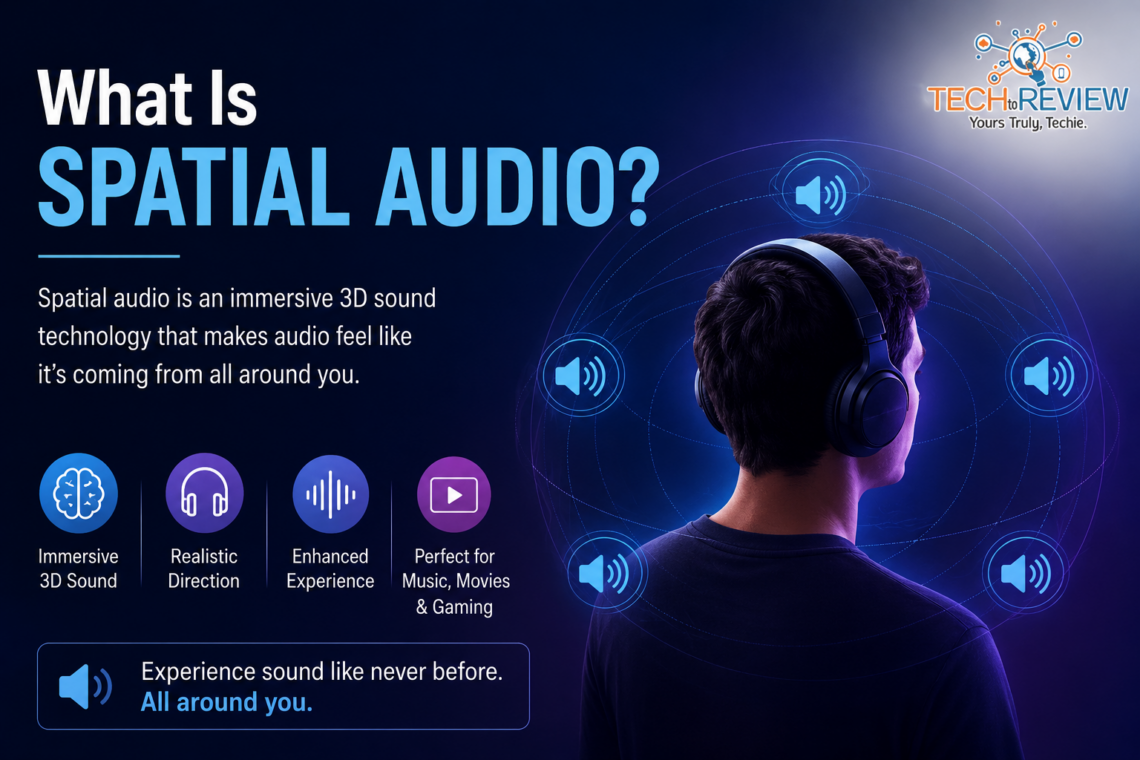
Spatial audio is designed to make sound feel three-dimensional. Instead of hearing audio only from the left and right channels, listeners can perceive sounds from different positions around them, including above and behind. This technology is becoming increasingly common in headphones, earbuds, soundbars, gaming systems, streaming platforms, and virtual reality devices.
What Is Spatial Audio?
So, what is spatial audio in simple terms? It is an audio technology that creates the perception of sound existing in a three-dimensional space. Traditional stereo separates audio between two primary channels: left and right. Spatial sound expands this experience by giving the listener a stronger sense of direction, distance, and movement.
For example, imagine watching an action movie. A vehicle moving from behind you to the front can sound as though it is actually traveling through your surroundings. Similarly, background music can appear to come from a wider area rather than from two fixed speaker positions.
This immersive approach can make entertainment feel more natural and engaging. However, the exact experience depends on the content, device, software, and audio format being used.
What Does Spatial Audio Mean for Everyday Listening?
Understanding what does spatial audio mean becomes easier when comparing it with ordinary stereo sound. Stereo primarily creates separation between left and right channels. Spatial technology attempts to recreate how humans naturally perceive sounds in the real world.
When someone speaks from your right side, your right ear receives the sound slightly before your left ear. Your brain uses differences in timing, volume, and frequency to determine where the sound originated.
Spatial processing uses similar principles digitally. Audio software modifies different characteristics of a sound signal so that your brain interprets it as coming from a particular location.
This is why spatial sound can create a greater feeling of depth and positioning, even when you are listening through relatively small earbuds.
How Does Spatial Audio Work?
Now that we understand what is spatial audio, it is useful to explore the technology behind it. One important concept is the Head-Related Transfer Function, commonly known as HRTF.
HRTFs describe how the shape of your head, ears, and upper body influences the way sound reaches your ears. Audio systems can use these characteristics to simulate different sound positions.
The technology can adjust several elements, including:
- Timing differences between the ears
- Volume differences between channels
- Frequency characteristics
- Sound reflections
- Perceived distance
- Direction and movement
When these elements are processed correctly, your brain receives audio cues that suggest a specific three-dimensional location.
Some advanced systems also include head tracking. In this setup, the audio environment can respond when you move your head. For example, if a sound appears to originate from a television and you turn your head, the system may maintain the sound’s position relative to the screen.
Spatial Audio for Movies and Television
Movies are one of the most obvious applications of immersive audio. Filmmakers can position dialogue, background effects, music, and environmental sounds within a virtual sound field.
Imagine a scene involving rain. With conventional stereo, the rain may primarily appear as background audio. With compatible spatial processing, individual elements can create a stronger impression of being surrounded by rainfall.
Formats such as Dolby Atmos can add height information to compatible content and equipment. This allows sound designers to create more detailed audio environments for supported movies and television programs.
For viewers, the result can be a more engaging cinematic experience without necessarily requiring a room full of individual speakers.
Spatial Audio for Music
Music is another growing application. Artists and producers can place instruments and vocals within a three-dimensional sound field, potentially creating a different listening experience from traditional stereo mixes.
Instead of simply separating instruments between left and right, compatible music can provide a wider perception of space. Vocals may feel centered while instruments and atmospheric effects appear around the listener.
However, not every song is produced for immersive audio. The quality of the experience depends on how the recording was mixed and whether your playback device supports the relevant format.
Spatial Audio for Gaming
Gaming can benefit significantly from positional sound. Knowing where an approaching vehicle, character, or environmental effect originates can contribute to immersion and situational awareness.
For example, footsteps coming from behind can provide a stronger directional cue than ordinary stereo playback. In supported games, this can make virtual environments feel more realistic.
Headphones with compatible spatial processing are particularly popular among gamers because they can provide directional cues without requiring multiple physical speakers.
Devices That Support Spatial Sound
Once you know what is spatial audio, you may wonder where you can experience it. Several types of devices can support spatial sound, depending on their hardware and software.
Headphones and Earbuds
Compatible headphones and earbuds are among the easiest ways to experience immersive audio. Some models also support head tracking for a more dynamic experience.
Soundbars
Modern soundbars can simulate a wider sound field and, in some cases, support formats such as Dolby Atmos. Some models use upward-firing speakers to create a sense of height.
Smart Speakers
Certain smart speakers support immersive formats and can provide a broader audio presentation than conventional compact speakers.
Gaming Devices
Compatible consoles, computers, games, and headsets can use spatial processing to create more detailed positional audio.
VR Headsets
Virtual reality is another important area for spatial sound. Because VR aims to create an immersive visual environment, realistic audio positioning can make the experience feel considerably more convincing.
Benefits of Spatial Audio
There are several reasons why this technology has become popular. First, it can create a greater sense of immersion. Second, it can improve the perception of direction in supported content. Third, it can make movies, games, and music feel more dynamic.
For gaming, positional information can be particularly useful. For movies, it can improve environmental realism. For music, it can provide an alternative way to experience compatible recordings.
Nevertheless, spatial sound is not automatically better in every situation. Some listeners may prefer traditional stereo, while the quality of immersive audio can vary depending on the recording and equipment.
What Do You Need to Experience It?
To experience spatial sound, you generally need three things: compatible content, compatible playback hardware, and software or a platform that supports the technology.
Before purchasing new equipment, check whether your preferred streaming service, headphones, smartphone, television, or gaming platform supports the same spatial format. Compatibility can differ between manufacturers and services.
Visit- https://searchies.online/
The Future of Immersive Audio
The growing popularity of immersive entertainment suggests that spatial audio will continue developing. Improvements in head tracking, personalized HRTFs, gaming, virtual reality, and streaming could make three-dimensional sound increasingly accessible.
Ultimately, what is spatial audio comes down to creating a more realistic perception of where sounds exist around you. By combining digital signal processing with the way human hearing works, it can transform ordinary listening into a more immersive experience.
From movies and music to gaming and virtual reality, spatial audio represents an important step beyond traditional stereo. As compatible content and devices become more common, three-dimensional listening could become an increasingly normal part of everyday entertainment.