Author
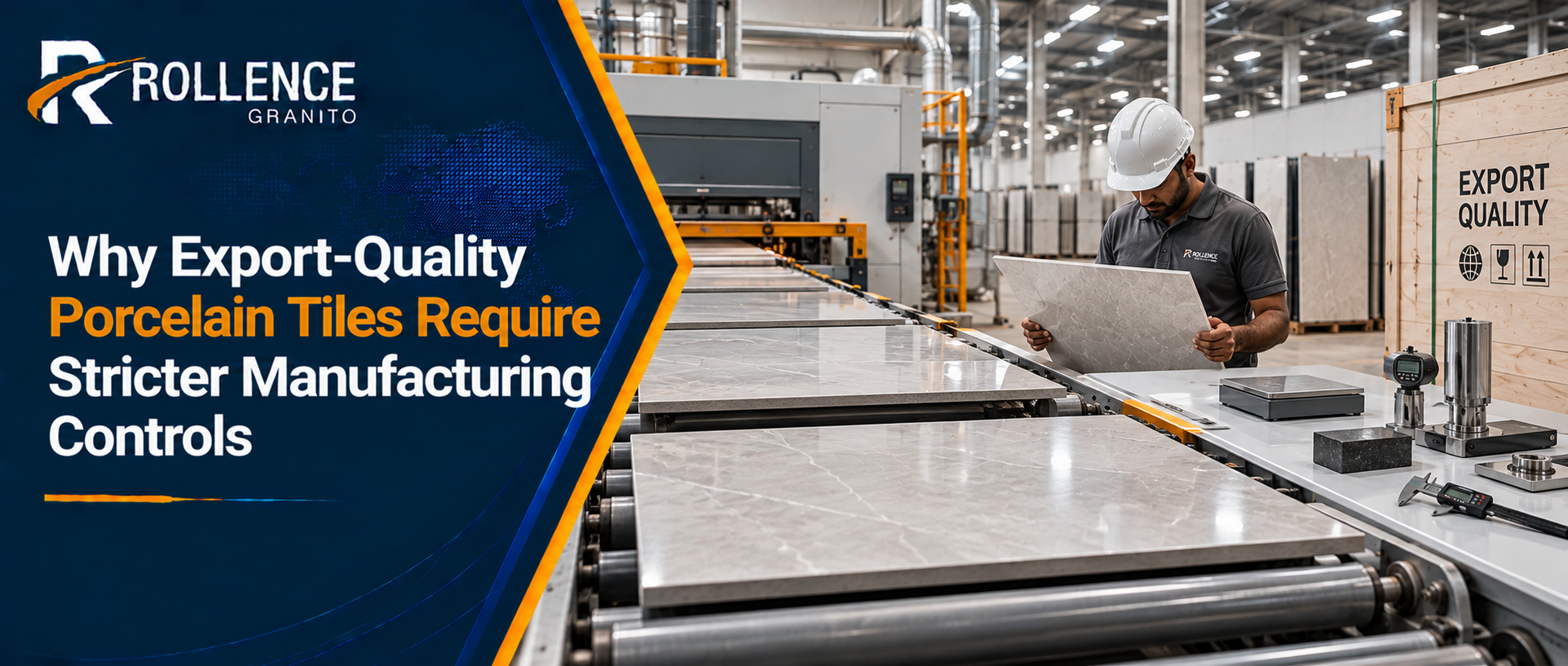
A tile sold domestically travels a short distance, is inspected on arrival, and reaches the installer within days. A tile exported to a market thousands of kilometres away must survive sea freight in varying humidity and temperature, pass customs inspection under a different regulatory framework, and arrive at a project site in a condition identical to the approved sample ordered months earlier. Those additional demands require stricter manufacturing controls at every stage of production, not as a marketing claim but as a practical necessity.
Batch Consistency Across Long Production Runs
Export orders are typically larger than domestic orders. A project in Iraq, Egypt, or another international destination may require several containers of tiles from the same production run, with the expectation that every tile across that entire consignment matches the approved shade and dimension. This requires porcelain tiles manufacturers to maintain raw material consistency, kiln temperature stability, and colour calibration across production runs that may span days or weeks. Any drift in those parameters produces shade variation between pallets that becomes visible when the tiles are mixed on site, a problem that is extremely difficult to resolve once tiles have shipped internationally.

Manufacturers with robust export programmes invest in spectrometric colour measurement of finished tiles, sorting by shade lots, and pallet labelling that identifies production batch and shade code. These systems allow the destination installer to manage any minor variation deliberately rather than discovering it mid-installation.
Packaging Standards for Sea Freight
Tiles damaged in transit arrive at a project site as scrap. Sea freight subjects packaging to stacking loads, vibration, humidity fluctuation, and handling at multiple ports. Export-grade tile packaging uses reinforced cartons with internal cardboard interleaving between tiles, corner protection on crates, and moisture-resistant wrapping for container environments. Large format tiles, which are more susceptible to edge chipping and cracking under point load from stacking, require additional packaging engineering that adds cost but is non-negotiable for tiles reaching international projects in usable condition.

Regulatory and Certification Requirements by Market
Different export markets impose different product certification requirements. European markets commonly require CE marking under EN 14411, which mandates third-party testing of water absorption, slip resistance, and dimensional tolerance. Middle Eastern markets including Iraq and the Gulf states increasingly require SASO certification or equivalent national standards. Each certification requires independent laboratory testing and documentation that must be maintained and updated as product ranges evolve. An exporter who cannot produce current certification for a specific market creates delays at customs that are costly to the project timeline and damaging to the supply relationship.
Dimensional Consistency Under Transit Stress
Porcelain tiles are dimensionally stable after firing, but packaging failure can allow tiles to shift and chip during long sea voyages. The dimensional tolerances achieved at the factory are what arrive at the destination only if the packaging system prevents tile-to-tile contact and point load concentration during transit. Manufacturers who treat export packaging as equivalent to domestic packaging consistently see higher breakage claims and customer satisfaction issues in their export markets. The additional packaging cost for proper export specification typically runs 3 to 5 percent of the tile value, a fraction of the cost of a breakage claim or a project delay.
After-Sales Support Across International Supply Chains
When a domestic customer identifies a quality issue, resolution is relatively fast. When an international customer identifies the same issue, the resolution path is long, expensive, and potentially relationship-ending. Export-focused porcelain tiles manufacturers invest in pre-shipment inspection protocols, quality hold procedures that stop non-conforming tiles from leaving the factory, and documentation systems that allow any quality issue to be traced back to a specific production batch. Those systems protect both the manufacturer’s reputation and the customer’s project timeline in a way that reactive quality management after shipment cannot.